How a near-death experience led to a career in turfgrass
By Matt Duncan, CSFM
How can the worst thing that has ever happened to you also be the best thing that has ever happened to you? This is a question I ask myself when reflecting on more than three decades in the turfgrass industry.
The year was 1995. I was a sophomore majoring in Sociology and Criminal Justice at Lock Haven University in Lock Haven, Pennsylvania. Then, in April of that year, my life took a turn I could have never expected.
On April 6, 1995, I went to the doctor back home in Williamsport and was told I had bronchitis with an infection in my lungs. He put me on some medicine and told me to go back to school.
After the appointment, two of my friends and I went to the Old Lycoming County Jail in downtown Williamsport to see the prison. As we walked around, my friends were a little ahead of me. I looked into one of the cells, and jumped back. There was a priest standing in the cell. He had a black suit with white collar, was carrying a Bible, and wore glasses. Not expecting to see anyone in there, I made a bit of small talk then caught up with my friends. I looked back and the priest was gone. I asked friends where he went, and they said there was no one in the cells — they were empty and locked.
I was still not feeling well when I went to bed on April 7, and I didn’t wake up for a couple of weeks. I had fallen into a coma, lost the ability to breathe on my own, had a tracheotomy, was placed on a respirator, and lost brain activity.
It was during that time that I had an out-of-body, near-death experience. I remember floating above my body and seeing myself lying there. I could hear doctors and nurses talking, and see what they were doing to my body. During this experience, I was able to move around the hospital floor and made my way to the waiting room. I could see and hear my parents, family and friends, but I could not interact with anyone.
I then drifted from the hospital to a setting that was white and cloud-like. I was near what looked like a gate, and everyone around me was wearing white religious robes. I was in a wheelchair, which made sense later when I woke up from my coma paralyzed from my neck down. I also could not speak to anyone, which made sense with my trach in my throat. Despite this, I felt comfortable in that surrounding.
There were many people there that I didn’t recognize, but eventually a familiar face came to me. His name was Walter Tempesco. He was my next door neighbor growing up, and his wife Mary used to babysit my sister and me until my parents got home from work. He was like a grandfather to me, and I was very close to him. When I was nine years old, Walter fell off of a ladder and died. Being young, I didn’t know how to react to the news, as he was my first experience with death.
Walter asked me, “Matt, what do you want? What do you want to do?” As mentioned, I couldn’t speak, but I was very comfortable there and wanted to stay. He kept asking what I wanted. He came back to me later and told me that I could not stay there, and that it was not my time, but I would have a chance again another day. The next thing I remember, I opened my eyes. I’m not sure how much time had passed between that experience and waking up. But it was later suggested to me that I had been pretty far gone.
I can’t adequately describe the feeling I had when I opened my eyes. I went from a feeling of comfort in the clouds to one of terror and fear. My eyes were the only thing I could move. I had a trach in my throat, a feeding tube in my stomach, a central line in my chest, catheters, IV's — tubes everywhere.
To make things worse, I didn’t recognize my parents right away, didn’t know where I was, didn’t know what happened to me, and couldn’t understand what the doctors and nurses were telling me.
What my doctor missed on April 6 was that I had viral encephalitis, which is inflammation of the brain. I was told that the particular strain I had contracted kills more than 80% of the people who contract it. Of those who live, more than half end up with mental disabilities.
I could not feel my body from my neck down. Over time, the fog that I was in lifted. I remembered my parents, and could understand things, but I could not yet communicate. Feeling slowly came back to my hands, then arms, then legs, and finally my feet. I eventually needed therapy to learn how to walk, how to talk, and how to eat food again. I continued with speech therapy, occupational therapy, and physical therapy after I was released from the hospital.
It was a grueling recovery that took time, tears, patience and prayers. My family and friends were warriors helping me get through it, and I cannot imagine what they went through or how they felt.
A NEW JOURNEY BEGINS
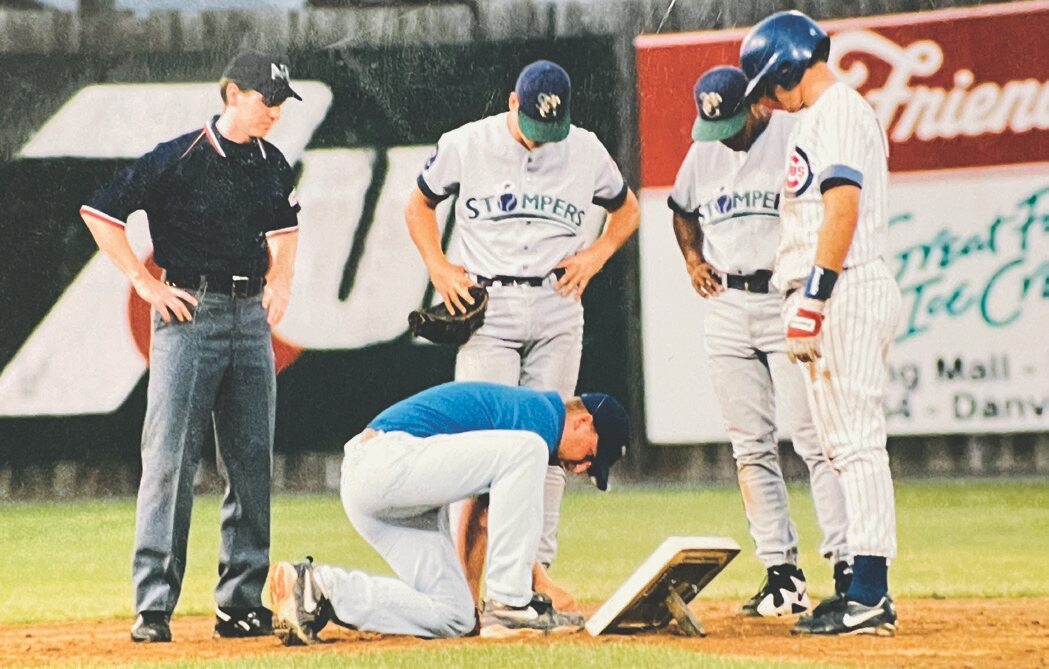
By summer I was well enough to walk, and was released from the hospital. But I was bored back at home while I was recovering. So, I decided to visit my fraternity brother, Roy Silvis, who was working as head groundskeeper at Bowman Field, the Minor League Baseball stadium in Williamsport that was home to the Short-Season Class A affiliate of the Chicago Cubs. It was far enough from my house that I normally would not have walked, but since I just re-learned how to use my legs, I wanted to keep them moving.
I walked to Bowman Field just to see Roy, but he asked if I wanted to be his assistant. It would mainly involve game day help watering, lining, moving screens, etc. I gladly accepted. I had played baseball during my freshman year of college, and wanted to be around the game.
That summer introduced me to a couple of people who would become mentors to me. First was Don Fowler, a Penn State Extension Specialist who also coordinated all of the volunteer efforts for the Little League World Series, which was played across the river. Don showed me how to work the clay on the mounds and plates, and gave me a lot of advice. The other was Lubie Veal, a former MLB head groundskeeper in Cincinnati, Montreal, and in Chicago at Wrigley Field. The Cubs would send Lubie to all of their minor league parks to ensure the fields were up to par.
For the next three summers, I got to continue working at Bowman Field as head groundskeeper thanks to General Manager Doug Estes taking a chance on a hometown kid with a strong work ethic and a desire to learn. I got to spend time with Lubie and pick his brain, and I learned a lot of the basics that I would build upon from there and carry with me to my next stops.
I then moved to Ohio to be head groundskeeper for the Mahoning Valley Scrapper, Class-A affiliate for the Cleveland Indians. They are now part of the MLB Draft League; and things have come full circle, as my son Connor is now the head groundskeeper at 17 years old.
From there, I went to the Akron Aeros, Double-A affiliate of the Cleveland Indians, and I also started working for the Cleveland Browns.
Prior to my hospitalization, I had no idea the turfgrass industry even existed, let alone that it would provide me with the chance to have a career in professional baseball. Through it all, the people of this industry have been the best part. They have given me so much, and have expected nothing in return. I would not be working in this industry if it weren’t for those who have taken chances on me. As a result, I always make it a point to give people a chance and stand up for those who are just looking for experience and a shot.
A general manager once asked me to recommend someone for his head groundskeeper position. His response about the person I recommended was, “He doesn’t have much experience.” I told him that nobody has experience until given a chance. He hired who I recommended, and that person eventually went on to be a Major League Baseball groundskeeper.
Through my experiences, I have learned to be grateful. When everything is taken away from you, you learn to not take life for granted and be appreciative of what you have. I also learned to tell the people around me what they mean to me and that I appreciate them. In addition to Don and Lubie, I am grateful for Darian Daily, Brian Gimbel, Brent Packer, Paul Curtis, Bob Hudzik, Jeff Fowler, R. D. Slingerland, Pam Sherratt, Dr. John Street, Chris Powell and Neal Pate. Some of them are no longer with us, but I hope that they know they were appreciated by me and many others. All of these people taught me not only how to be a better turf manager, but how to pay it forward and help others.
I will never fully understand why I was saved and given a new lease on life. What I do know is that I am eternally grateful for my second chance at life and all of the people I have in it. But you don’t have to go through a near-death experience to understand the importance of taking time to appreciate the gifts you have been given and the people who impact you every day.
For the rest of my career, I will continue to think back to 1995, how my life took a turn, and how the worst thing that has ever happened to me became the best thing that has ever happened to me, because it brought me into the turfgrass industry.
Matt Duncan, CSFM, is a professional turf account manager for DLF, and serves as vice president – commercial on the SFMA Board of Directors.