A New Jersey Gem
The history of Raymond J. Cipperly Field
By Bradley S. Park
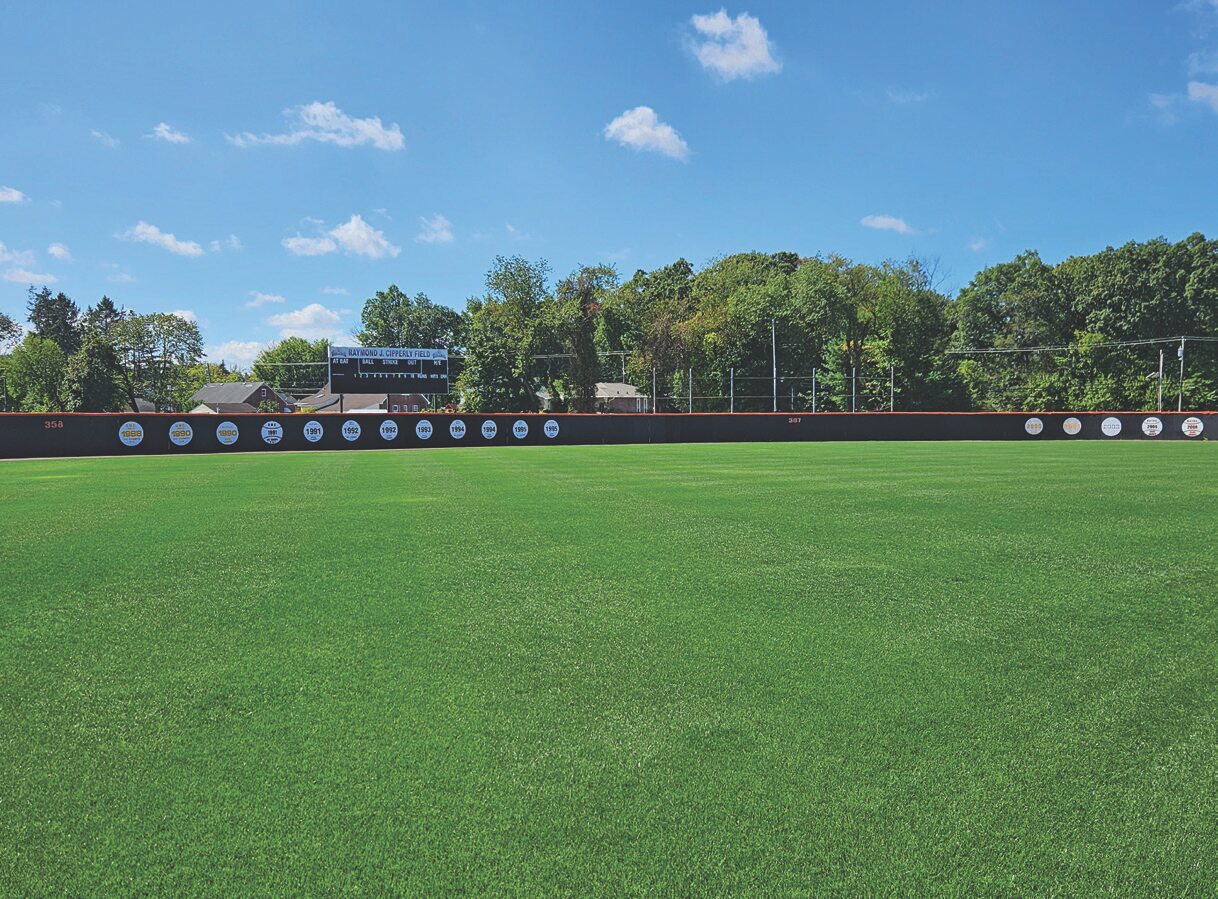
Positioned between New York City and Philadelphia, Middlesex County New Jersey is proud of its nickname: The Greatest County in the Land. Middlesex County has a Magnet School system in which its premier baseball field was deemed the Greatest Field in the Land on two occasions by the Sports Field Management Association (SFMA), having twice won the Schools and Parks Baseball Field of the Year award. Raymond J. Cipperly Field, East Brunswick, New Jersey, has a rich past filled with well-deserved accolades. It also has a history of well-documented efforts to control annual bluegrass (Poa annua L.).
FIELD HISTORY AND NAMESAKE
The flagship natural turfgrass baseball field in the county’s Magnet School System, the former Tiger Field was re-dedicated as Raymond J. Cipperly Field in May 2016 following the untimely passing of Raymond “Ray ” Cipperly in October 2015. Cipperly began teaching physical education at East Brunswick Magnet School (formerly East Brunswick Vo-Tech) in the early 1970s, and became the school’s base- ball coach in 1975. Cipperly stepped down as coach in 1996 to become athletic director for Middlesex County Magnet Schools (formerly Middlesex County Vocational Technical Schools) (Tufaro, 2016).
An article from mycentraljersey.com noted that Cipperly attended a World Series game in the 1950s at Yankee Stadium, and that this visit fueled his passion for the game of baseball, as well as his interest in the particulars of baseball diamonds. He was inspired to design, build and oversee substantial upgrades to the field that was re-named in his honor (Tufaro, 2016). A plaque on the third baseline dugout reads, “The Field that Ray Built.”
Further illustrating his work ethic and skill set, Cipperly also served as head groundskeeper for the Trenton Thunder and subsequently the Somerset Patriots in Bridgewater, New Jersey (now the Double-A affiliate of the New York Yankees). Cipperly’s abilities in the area of baseball skin surface management and his communication skills were quickly recognized by Dr. Henry Indyk, longtime Extension specialist at Rutgers University, and 1994 recipient of the
SFMA Harry Gill Award. Indyk was curriculum coordinator for Rutgers ’ Annual Athletic Field Maintenance and Construction continuing education course, and Cipperly served as an instructor in the course for many years. During that time, Cipperly delivered practical “ how-to ” baseball and softball skin surface management education to hundreds of school, municipal, and county park sports field and grounds managers that attended the course. Many of the images associated with this article are scans of 35mm slides Cipperly used during his Rutgers Office of Continuing Professional Education course lecture.
But Cipperly’s commitment to sharing his knowledge and expertise extended beyond the Rutgers Continuing Education classroom. He hosted two highly successful Sports Field Managers Association of New Jersey (SFMANJ) baseball infield-focused education events at what was then Tiger Field. A 2011 Infield Maintenance Clinic featured presentations by Bill Deacon, head groundskeeper of the New York Mets, and Mike Boekholder, head groundskeeper of the Philadelphia Phillies. In 2013, Cipperly hosted the SFMANJ Fall Field Day with Deacon and other professional baseball groundskeepers such as Dan Purner (Somerset Patriots) and Mike Morvay (Lakewood BlueClaws).
For his efforts, Cipperly was posthumously awarded the inaugural (2015) SFMANJ Dr. Henry Indyk Memorial Award, which honors an individual who has demonstrated “ a tireless commitment of service and hard work contributing to the advancement of both sports fields and sports field managers in New Jersey.”
AWARDS AND ACCOLADES
Sports Turf Managers Association (which later became SFMA) selected Tiger Field as its Field of the Year in the Schools and Parks Baseball category for 1990. A detailed article in the May 1991 issue of Golf & sportsTurf titled “Tiger Field earns its stripes,” noted that organized baseball at East Brunswick Magnet School began in the mid-1970s and the need for a home playing surface became recognized (Trulio, 1991). Cipperly and a school administrator examined an unimproved turfgrass stand on school grounds late one afternoon and sited locations for the bases relative to the position of the soon-tobe-setting sun. The playing surface had humble beginnings: weeds, bare spots, rocks scraped away by players before every game, and an infield created using a sod cutter.
Under the direction of Cipperly, playing surface quality and field definition improved. In subsequent years, conventional infield mix was imported, improved turfgrasses were introduced, and a warning track was installed. Fencing was established and carpentry students built two dugouts and a backstop. By 1990, pre-game skin surface watering was being practiced, a robust turfgrass fertilization schedule was in place, and mowing was performed every other day at 1.5-inch. The 1991 article concluded, “Judging from the Tigers ’pristine diamond and winning record, feeling ‘almost like a pro’has its advantages. Tiger Field, the 1990 high school / park / municipal Diamond of the Year, is a training ground, not only for hopeful ballplayers, but also perhaps for future sports field superintendents. It’s a living classroom for students of the game, from the ground up.”
Soon after winning the Field of the Year award, Cipperly was presented with the New Jersey Turfgrass Association Recognition Award for 1992. Four years later, the National High School Baseball Coaches Association named Cipperly and his field as the Region 1 National Groundskeeper / Field of the Year for 1996.
The Field that Ray Built was named the SFMANJ Field of the Year for 2016. Ryan Radcliffe managed Cipperly Field in 2016, as well as the sports and grounds at five Magnet School campus locations throughout Middlesex County. Radcliffe’s professional baseball dossier included time spent with the Reading Fightin’ Phils (then Reading Phillies) and Lakewood BlueClaws. Scott Bills, CSFM, noted that efforts put forth by Radcliffe and his staff continued the tradition of excellence established by Cipperly and that, “ the result is arguably the absolute best high school baseball field in New Jersey.”
Four years later, Keith Fisher, whose professional resume consisted of time served as an assistant groundskeeper with the New York Yankees, was in charge of the Middlesex County Magnet Schools’ sports fields and grounds. Under Fisher, Cipperly Field was selected as the SFMA Field of the Year in the Schools and Parks Baseball category for 2020 (SportsField Management, 2021). Fisher noted that “Cipperly Field was held to a very high standard in the community and the standard is maintained by being passionate about the success and playability of the surface — which rivals Minor League Baseball fields and compares to Major League quality.”
Today, in addition to East Brunswick Magnet School home games, Cipperly Field hosts the Greater Middlesex County (GMC) High School Baseball Tournament each May. Many in the local high school baseball community are well aware of Cipperly Field’s national recognition. Vinnie Abene, head baseball coach of Edison High School and co-president of GMC Baseball Coaches Association, stated, “We’ve obviously known about this gem for the past 25 years or longer, and we look forward to playing as many games as possible on that field. It’s well taken care of. The staff at East Brunswick Tech does an unbelievable job keeping that field in the best shape.” (Tufaro, 2020).
ANNUAL BLUEGRASS
Throughout much of its history, annual bluegrass has been a long-term, nagging problem in the baseball outfield of Cipperly Field. Elevated cultural practices that are common in professional baseball — including a mowing height that has rarely exceeded 1.5-inch, automatic irrigation, and the supply of ample plant nutrition — are among the factors contributing to the persistence of annual bluegrass. As the grassy weed has taken hold — even where efforts have been made intermittently over the years to arrest the problem — the persistence of a significant annual bluegrass seed bank in the soil has allowed successive iterations of the population to reestablish.
As reported in the March 2005 issue of SportsTurf, the first — and most aggressive — effort to control annual bluegrass (both the baseball outfield turf cover and the soil seedbank below) involved the application of dazomet (Basamid G) in late summer 2004 (Park, 2005). Similar to practices employed for golf course fairway renovation, dazomet was applied to the surface of the outfield in August 2004 to provide nonselective control of the existing turfgrass and annual bluegrass cover, as well as control of the underlying soil seedbank. The application was watered in, and irrigation runs over subsequent days were made to seal the fumigant in the soil and improve control of the annual bluegrass seedbank. A blend of five Kentucky bluegrass varieties was seeded two weeks after the dazomet application. Kentucky bluegrass establishment was rapid that autumn and a playable surface formed by spring 2005. This strategy, however, did not provide a permanent solution to the annual bluegrass dilemma.
Cipperly Field and annual bluegrass were again the subjects of an article in SportsTurf in 2015. The article detailed the renovation efforts during 2004, annual bluegrass re-incursion, and a new strategy that involved mesotrione (Tenacity Herbicide) applied four weeks in a row during spring 2013 followed by three applications of amicarbazone (Xonerate Herbicide) every 10 days during autumn 2013 (Himes, 2015). Cipperly was quoted as observing “a lot less Poa annua” the following spring, and he and Radcliffe repeated the mesotrione and amicarbazone application program during 2014, with a modification during autumn of that year that included a tank mixture of the two chemistries. Short term success? Perhaps.
RECENT EFFORTS
The calendar eventually turned to 2024, and a new crop of annual bluegrass, emanating from the ever-persistent annual bluegrass seedbank, had taken hold in the Cipperly Field outfield. The prolific nature of an annual bluegrass seedbank should not be underestimated; one researcher suggested that the surface layer of soil might contain 30 million annual bluegrass seeds per acre where annual bluegrass has persisted (Renney, 1964). The next generation of annual bluegrass was met with new tactics and a new sports field manager, Mike Morvay.
A graduate of the Rutgers University turfgrass program, Morvay’s career included extensive time working in professional baseball. Morvay and I concluded that a late summer and autumn nonselective renovation program was the best course of action per visual inspection of the outfield (and my knowledge of prior renovation efforts). Research conducted at Rutgers would serve as the blueprint for the renovation strategy (Park and coworkers, 2019). The crux of the plan involved changing the species composition of the outfield to perennial ryegrass and capitalizing on the tolerance of perennial ryegrass to the herbicide ethofumesate (Prograss 1.5 EC), which has selective postemergence activity on annual bluegrass, particularly at elevated rates and when annual bluegrass is in the seedling stage.
A nonselective herbicide was applied to the Cipperly Field outfield in mid-August 2024. Following complete control of the outfield, a blend of three perennial ryegrass varieties was slit-seeded on August 28, 2024; two of the three varieties had demonstrated elevated tolerance to gray leaf spot disease in research trials. As expected, perennial ryegrass seedling development was rapid during late summer and early autumn; the first mow occurred on the new outfield surface on September 16, 2024. Three applications of ethofumesate (Prograss 1.5 EC; 170 fl. oz./acre) were made in October, November and December roughly 30 days apart. Application and seeding deadlines were met within a day or two of intended targets and Cipperly Field, as in previous years, successfully hosted the GMC high school baseball tournament semifinals and final over Memorial Day weekend, 2025.
A visit was made to Cipperly Field in mid-September 2025, one-year after renovation. Morvay and I estimated annual bluegrass control was >95% throughout the outfield. Additional ethofumesate applications were made in mid-October and mid-November 2025 for control of any new annual bluegrass emergence. The status of annual bluegrass incursion as of the writing of this article? So far, so good. What will be the next chapter in the storied history of Cipperly Field? Stay tuned.
Author’s note:
Raymond J. Cipperly Field has served as a case study on many levels: Field upgrades, skin surface material selection and management, annual bluegrass control, the list goes on. The success of the field continues to demonstrate the importance of trained sports field managers with a vested interest in maintaining and improving their playing surfaces and the ongoing commitment on the part of Middlesex County Magnet Schools to invest in sports field management personnel with advanced training and experience.
Bradley S. Park is research and outreach agronomist, Rutgers University; a member of the Sports Field Managers Association of New Jersey (SFMANJ) Board of Directors since 2003; SFMANJ Historian; and recipient of the New Jersey Turfgrass Association Recognition Award (2016) and SFMA Dr. William H. Daniel Founders Award (2024). He can be reached via email at bradley.s.park@rutgers.edu
References:
Bills, S. 2017. 2016 Field of the Year. SFMANJ Update 17(1): 5,8,16.
Himes, C. 2015. Solving Poa annua problems in New Jersey. SportsTurf 31(2):42-43.
Park, B. 2005. Renovation of Tiger Field, East Brunswick, NJ. SportsTurf 21(3):34-35.
Park, B. 2019. The importance of sports turf managers for schools and municipalities. SportsTurf 35(1):10-12.
Park, B.S., Elmore, M.T. and Murphy, J.A. 2019. Using herbicides and perennial ryegrass to renovate turf dominated by annual bluegrass. Crop, Forage & Turfgrass Mgmt. 5: 1-7 190005. https://doi.org/10.2134/cftm2019.01.0005
Renney, A.J. 1964. Preventing Poa annua infestations. 18th Annual Northwest Turfgrass Conf. Proc. pp. 3-5.
SportsField Management. 2021. Field of the Year School and Parks Baseball: Ray Cipperly Memorial Baseball Field. SportsField Mgmt. 37(4) 10-12,14-16.
Trulio, M. 1991. Tiger Field earns its stripes. Golf and SportsTurf 7(5):22-26.
Tufaro, G. (2016, May 18). Ceremony dedicating “Field that Ray Built” honor Cipperly. Mycentraljersey. https://www.mycentraljersey.com/story/sports/high-school/baseball/2016/05/18/ceremony-dedicating-field-ray-built-honors-cipperly/84533352/
Tufaro, G. (2020, December 2). East Brunswick Tech baseball diamond named nation’s best. Mycentraljersey.com. https://www.mycentraljersey.com/story/sports/high-school/baseball/2020/12/02/east-brunswick-tech-baseball-diamond-named-nations-best/3793169001/