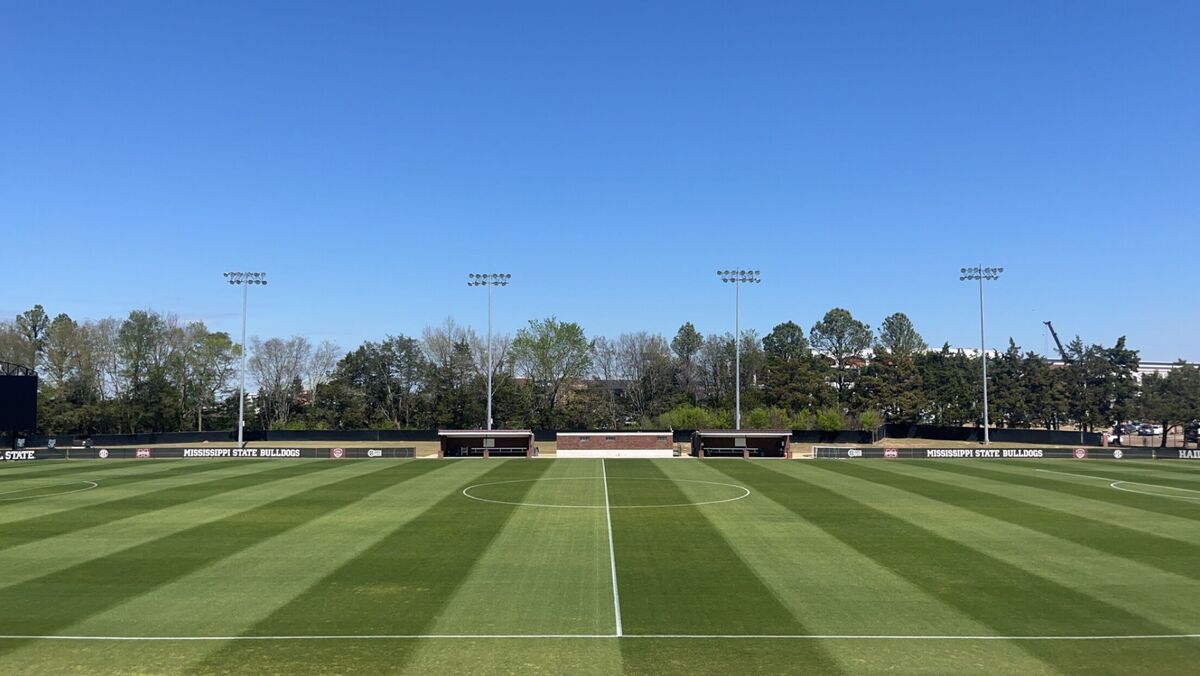
MSU Soccer Field:
Mississippi State University, Starkville, Mississippi
Our soccer field is 14 years old with only a sand cap over 20-foot center drain lines on 0.50 percent slope. Due to budget restrictions during the renovation, we had to use north Mississippi clay based 419 sod. As I tell my assistants, we may as well have laid a tarp under the sod. It took two years of solid and coring tines to make the field drain properly. This consistent management over the last 14 years has this field performing as one of the best draining fields on campus — if not the best. When Hurricane Francine came through — blessing us with upwards of 5 inches of rain — we were confident that if we had two to three hours of no rain prior to our match that night that the field would perform flawlessly. Just hours after the hurricane had passed, the field performed just as I expected, and Mississippi State was able to defeat Abilene Christian 5-0. In complete honesty, the field surprised me; after 16 years of experience in this industry, that’s doing something.
Having to utilize student labor brings its own set of challenges. Balancing each student’s time is very important to me; after all, they are here to get an education — not work full time. It is very challenging to ensure that everything gets done on the Athletic department’s requested schedules due to the students being in and out all day. It is imperative that we completely utilize the time that the students are here, and keep the overtime as low as possible while still providing the safest, most aesthetically pleasing fields possible. When our soccer field is finished and the television cameras come on, the final product that everyone sees is done mostly by students under the guidance of Hayes McMullen. This field is often used as a teaching ground for our students to learn how to mow, spray, paint and aerate. Teaching the next generation of sports field managers is very important to me.
I am blessed to have a stellar staff of full-time employees, as well as a great crew of students willing and eager to learn as much as they can. These types of awards are very enticing to our students, as they seem to listen a bit more when discussed. When students walk into my office and see all of our awards, they usually ask tons of questions about each award. The Field of the Year program has helped not only me, but all of my full-time employees as well. Administration listens and is more appreciative when these awards are part of our departments.
– Brandon Hardin, associate director, athletic grounds
Level and category of submission: College Soccer
Field manager: Brandon Hardin
Title: Associate director, athletic grounds
Education: Bachelor of Science in Agronomy with an emphasis in golf and sports turf management
Experience: Student employee, Mississippi State (2001-06); intern, Roger Dean Stadium, Jupiter, Florida (2005); assistant manager of facilities and grounds, Louisiana State University (2007-08); assistant superintendent/sports turf, facilities management, Mississippi State University (2008-14); superintendent/sports turf, facilities management, Mississippi State University (2014- 22); associate director, athletic grounds, Mississippi State University (2022-Present).
Full-time staff: Hayes McMullen
Original facility construction: 1995
Turfgrass: Certified clay based Tifway 419 bermuda
Overseed: Champion GQ perennial ryegrass
Rootzone: Sand
Drainage System: Herringbone
SportsField Management (SFM): Congratulations on the Field of the Year win. What are you most proud of with this win?
Brandon Hardin: Our soccer field is our oldest field on campus, so to see it get this recognition means the world to us.
SFM: What were the biggest challenges you have faced with the winning field, and how have you approached those challenges?
Hardin: Little to no downtime is always a challenge (we have a very small window to get our things done); and weather is another concern. For example, we received more than a foot of rain in just the month of May (2025), and received another 6 inches of rain in four hours — which is the ninth highest amount of rain in a 24-hour window in the 132 years of data that we have.
SFM: Can you share a little about your overall management approach to the winning field and what you feel have been the most important aspects to getting this field to an awardwinning level?
Hardin: A soccer pitch is agronomically maintained a lot more tediously than a football field. Whereas with most fields we concentrate on footing and surface hardness numbers, for soccer we have the added variables of ball roll and ball skip — along with all the other factors that we look at daily. Hayes McMullen (sports turf specialist) has done a fantastic job of managing our pitch for our student athletes.
SFM: Please tell us about your crew , and anything else you would like us to know about your organization and the fields / facilities that you manage?
Hardin: Hayes manages our soccer pitch daily, and has three to four students at his discretion when needed. He coordinates directly with the soccer staff every day to make sure everything is ready to go for our student athletes.
SFM: Can you share a bit of insight into what the Field of the Year application process was like for you, as well as any tips you might have for other sports field managers?
Hardin: The process can be a bit tedious and time consuming with providing the overall information, but that’s just part of it. Start to finish you have to be able to tell the story of your field. I hear all the time from people who apply but only include the “glamor shots” in the package. Tell the story — the struggles, the good, the bad and the ugly. There’s plenty of time for the glamour shots. Our soccer field is the oldest field on campus. We renovated the field in 2010 with a sand pea gravel sand cap root one. Budget constraints were a real challenge back then. The sand cap is still performing flawlessly. For the first three years we struggled with drainage due to having to use a heavy clay cheaper sod. Over three years with very aggressive core aeration and sand topdressing we got the field to drain properly, and it has done so ever since. I am proud of the work we’ve accomplished on our soccer field over the years.
The Field of the Year Awards program is made possible by the support of sponsors Carolina Green, World Class Athletic Surfaces and The Aquatrols Company.