Labor Multiplier
Teams deliver more value when autonomous mowers handle the routine
By Colin Busse
For years, landscaping companies have faced a familiar challenge: strong demand for services paired with limited labor capacity. Crews spend significant time on repetitive production mowing, leaving less room for detail work, customer engagement and property enhancements that truly differentiate a contractor. Autonomous mowing technology offers a different path forward. Rather than focusing solely on hiring to keep up with demand, contractors can unlock more value from the skilled teams they already have. By shifting routine mowing to autonomous equipment, companies free their crews to concentrate on higher-impact tasks that strengthen quality, customer relationships and long-term growth.
Freeing crews for higher-value work
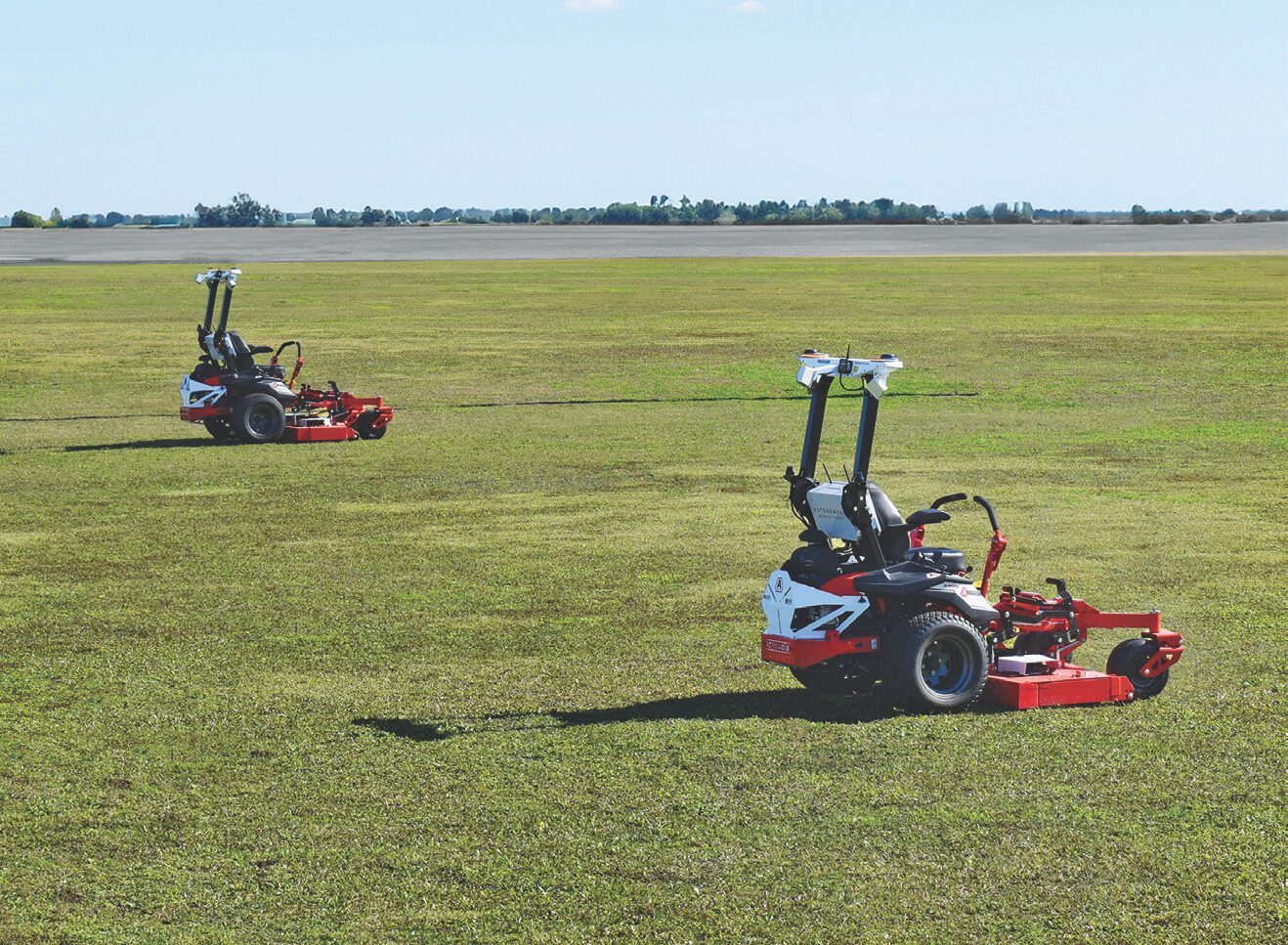
When labor is tight, teams have less time to focus on the detailed work that enhances the overall quality of their services. Large expanses of turf require hours of repetitive mowing, often tying up multiple employees on work that, while necessary, does not fully leverage their skills. Autonomous mowers change that equation. By handling predictable, open-area mowing, autonomous equipment allows a trained operator to oversee multiple machines while focusing on trimming, edging, site inspections and quality control. Instead of assigning several crew members to repetitive production work, contractors can redeploy talent toward detailed craftsmanship and proactive property management.
This is not about replacing skilled employees. It is about elevating how their time is spent. Autonomous mowers take on the most routine aspects of turf maintenance, creating space for crews to deliver higher-value services that customers notice and appreciate.
Elevating the role of the operator
In landscaping, expertise matters. Yet too often, skilled employees spend much of their day on tasks that require endurance more than judgment.
Autonomy reshapes that dynamic. Operators transition from simply driving equipment to managing performance, overseeing multiple machines and ensuring consistent outcomes across a property. Crew members gain time to focus on enhancements, curb appeal and detail-oriented work that improves overall presentation.
As responsibilities evolve, roles become more engaging and skill-driven. Surveys show that 76% of employees are more likely to stay with companies that offer continuous training opportunities.
The same is true in the landscaping industry. Employees who see clearer pathways for development, training and increased responsibility are more apt to stay. In a competitive labor market, offering more significant work can be just as important as offering competitive wages.
Autonomous mowing supports a model where people are positioned where they create the most value by applying their expertise, interacting with customers and ensuring quality, while technology handles repetitive production tasks.
Strengthening customer experience
When crews are stretched thin, communication and proactive service can suffer. Schedules become reactive and supervisors spend valuable time solving staffing challenges instead of strengthening client relationships.
With autonomous equipment maintaining consistent mowing schedules, operations become more predictable. Managers gain time for site walkthroughs, strategic planning and proactive conversations. Ground crews can focus on value-added services that enhance the overall customer experience rather than rushing to complete baseline tasks.
That shift matters. Sustainable growth in landscaping is not simply about covering more ground. It is about delivering consistent quality, building trust and expanding service offerings.
When teams have the bandwidth to focus on these priorities, companies become stronger partners to their clients.
A strategic shift in how work gets done
Investing in autonomous mowing is not just about efficiency. It is about redesigning how labor is deployed.
Landscaping businesses that rely solely on expanding their workforce to increase output will continue to face labor constraints and rising costs. Autonomous equipment provides another level. It increases capacity by reallocating human effort toward higher-value contributions.
The most successful adopters treat autonomy as an augmentation tool. Technology handles repetitive mowing. Skilled professionals focus on oversight, quality, customer engagement and specialized services.
Landscaping will always depend on experienced people. Autonomous mowers simply ensure those professionals spend less time on routine production and more time on work that requires differentiation, skill and experience.
In that model, growth is not powered by adding more labor hours. It is powered by elevating how those hours are used.
Colin Busse is the autonomous operations director at RC Mowers. A graduate of The Ohio State University, he previously held leadership roles with Electric Sheep Robotics and BrightView Landscapes. For more information about RC Mowers, visit www.rcmowersusa.com.