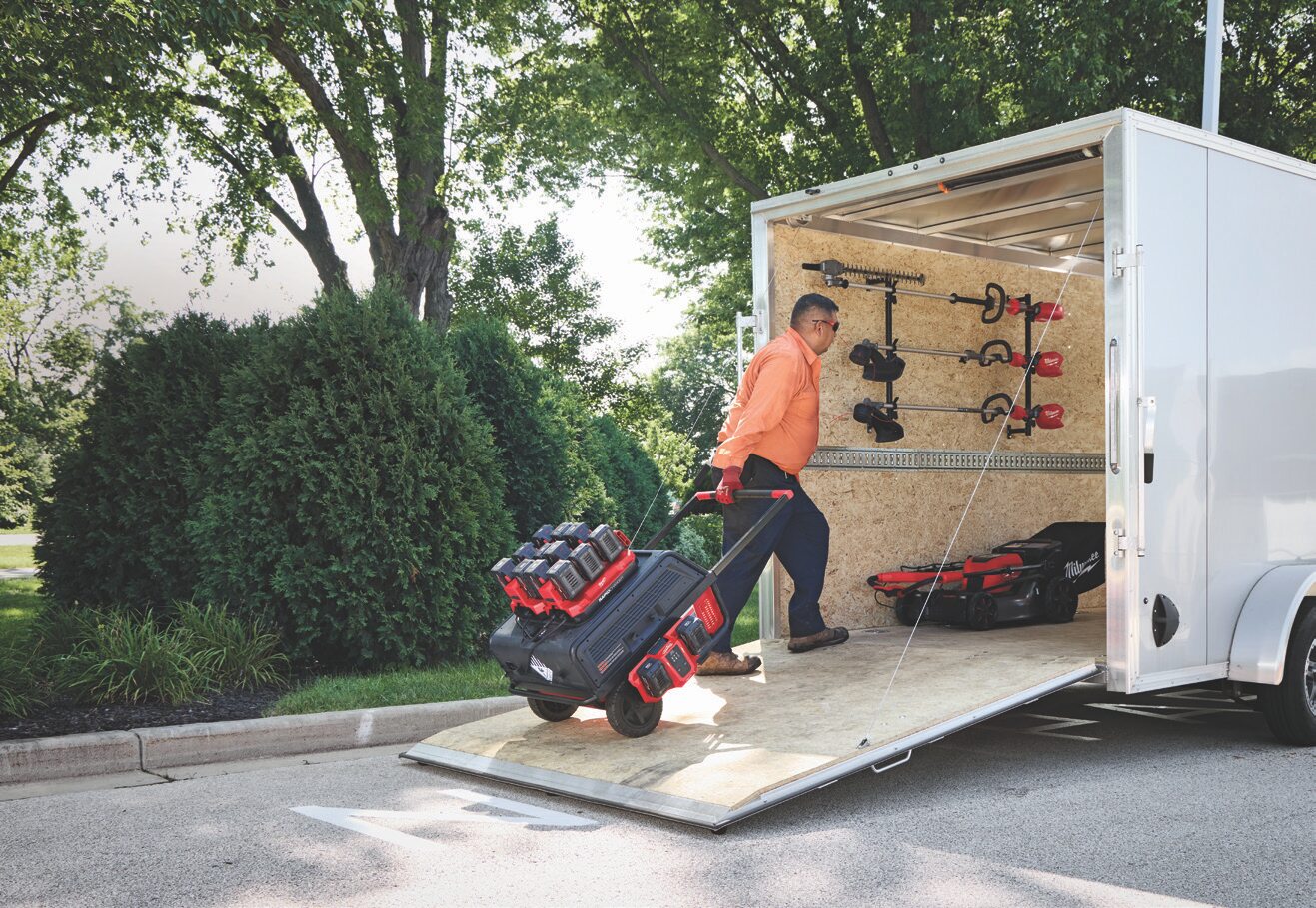
Powering Productivity
Understanding the Evolving Landscape of Battery Charging
By Jake Van Wormer
As battery-powered equipment becomes more widespread across professional landscaping and grounds maintenance work, both dealers and professional users are navigating an operational shift that goes far beyond choosing the right equipment. As the outdoor industry accelerates its transition from gas to battery-driven systems, charging has emerged as one of the most critical, and often misunderstood elements of a successful battery strategy.
While conversations around batteries often center on run time, power and durability, the supporting charging infrastructure plays an equally significant role in productivity, safety and long-term scalability. What was once as simple as plugging in a charger now requires thoughtful planning to support daily workloads and prepare a shop, trailer or fleet for future growth.
Across the industry, both manufacturers and professional users are recognizing that well-designed charging workflows are essential to keeping crews efficient rather than slowing them down. Whether that means outfitting a centralized shop, building a mobile setup or enabling real-time power replenishment throughout the day, streamlining charging workflows for efficiency is a top priority.
Circuit capacity and power management: The foundation of efficient charging
One of the earliest hurdles encountered by teams transitioning to battery equipment is understanding how much electrical capacity they truly need. Battery charging introduces a continuous power demand that varies based on:
Battery size
Charger power requirements
Number of batteries charging simultaneously
Battery age and state of charge
Temperature conditions
Because chargers draw unequal power at different stages of a charging cycle, many crews have discovered that simply adding outlets or plugging in more chargers does not automatically translate into safe or efficient charging. Overloaded circuits, tripped breakers or uneven charging cycles can quickly disrupt operations.
To overcome this, professionals increasingly rely on power management solutions that help distribute electrical load more intelligently. The overarching trend is toward tools and strategies that minimize the need for major electrical upgrades. As battery fleets expand, power awareness becomes just as important as tool selection.
Adapting charging strategies to real workflows
Professionals approach charging in different ways depending on fleet size, daily demand and the pace of their operations. Many start with overnight charging in a shop, which can work well for small or growing battery fleets. As teams take on more equipment or increase their reliance on battery power, daytime charging becomes more common. This requires deliberate planning around available power and charger accessibility. An increasing number of crews now rely on trailer or on-site charging setups.
Keeping batteries where the work happens can reduce the total number required for the fleet and improve efficiency by eliminating the daily cycle of loading and unloading packs. Each of these charging environments has distinct considerations, but all must account for the realities of field work.
Considerations in charging environments
As charging increasingly moves into the field, trailers are becoming mobile energy hubs that support a full day of work. This shift brings added importance to how charging systems are mounted and arranged, especially in environments where heavy equipment, debris and constant vibration are the norm. Chargers need to be securely positioned with proper airflow, and cords must be elevated or routed away from loading paths to prevent snags or trip hazards. Protecting batteries from vibration and placing chargers in intuitive, high-traffic areas ensures operators can swap packs naturally as they move between tasks.
A well-organized trailer also contributes directly to workflow efficiency. Positioning charging stations where crews transition between properties streamlines battery changes, reduces unnecessary steps and helps maintain momentum throughout the day. Clear separation between storage, charging and equipment zones minimizes clutter and reduces the chance of accidental damage. By prioritizing both safety and practicality, trailer layouts can dramatically reduce daily friction and help teams stay productive from the first stop to the last.
Planning battery needs through real-world usage
Many users determine their battery needs based on peak runtime claims or the assumption that more batteries always equal better preparedness. In practice, the most reliable method is to map average daily runtime across tools and determine how many discharges a crew will experience in a day. This approach gives a clearer picture of the workload the charging system must support. Access to power during the day, whether at a shop, trailer or jobsite, can significantly reduce the total number of batteries a team must purchase. Faster charging or on-trailer charging allows crews to reuse batteries multiple times throughout the day, often cutting required inventory and simplifying the overall system.
Retrofitting vs. starting from scratch
Professionals question whether adopting battery power requires a complete overhaul of their trailer or charging space. In most cases, it does not. Many charging systems and storage solutions are designed to integrate with existing setups, allowing crews to retrofit gradually without disrupting established workflows. Maintaining familiar operational rhythms while upgrading power infrastructure helps teams adapt more easily and avoids large upfront investments.
Choosing flexible and scalable charging ecosystems
As fleets expand and technology evolves, compatibility becomes increasingly important. Many professionals operate tools and equipment from multiple brands, which complicates charging environments. Managing several incompatible chargers can clutter trailers, slow down workflows and create confusion. Simplifying platforms helps maintain consistency and reduces training and management burdens. Systems that maintain consistent interfaces and demonstrate long-term compatibility offer better value, ensuring that today’s battery purchases continue to support tomorrow’s tools. Minimizing platform variety also makes energy deployment more predictable and streamlined in daily operations.
Building a future-ready charging strategy
The shift toward battery power offers significant benefits, from reduced emissions to simplified maintenance, but the full value is only realized when charging is planned intentionally. Charging strategy has become a key driver of operational success, influencing uptime, total cost of ownership and scalability. Dealers who understand these real-world considerations can guide customers more effectively, while end users who invest in thoughtful, adaptable charging environments position themselves for long-term productivity as technology continues to evolve.
Jake Van Wormer is group product manager at Milwaukee Tool.