Tom Guess, CEO, NASBLA
By Wanda Kenton Smith
With a stellar 38-year marine industry career spanning active-duty Coast Guard service to his appointment to CEO of the National Association of State Boating Law Administrators (NASBLA) in March, Tom Guess b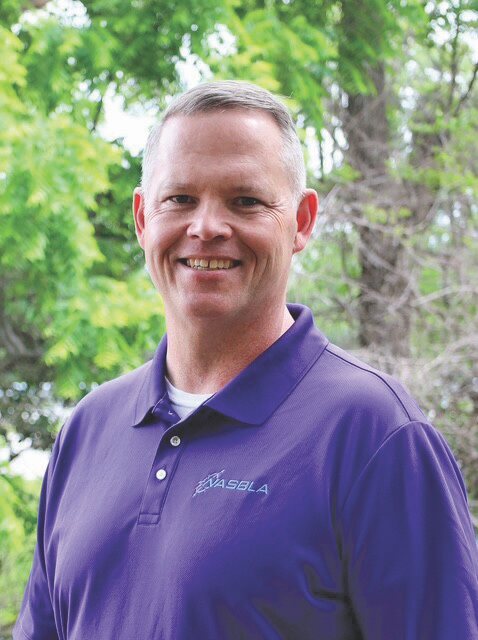 rings a wealth of boating safety experience and passion to his new role.
As a youngster introduced to the waterways by his grandfather on Chesapeake Bay, his personal engagement in boating encompasses water skiing as a teenager, to fishing aboard small Jon boats, to paddling on countless river trips with family and friends.
Professionally, Guess launched his career as a coxswain and boating officer in the U.S. Coast Guard. He rose through the ranks to head command positions at USCG stations including a three-year stint in the Outer Banks where he dealt with user conflict issues between charter boat captains and recreational anglers at the Oregon Inlet.
Additional posts followed, including law enforcement instructor at the Coast Guard Maritime Law Enforcement School (now Academy) where he taught state marine patrol officers about Federal Boating Regulations, instructor development and Boating Under the Influence.
From 2008 to 2023, he worked for the Virginia Department of Wildlife Resources, including 13 years as the State Boating Law Administrator, and its first-ever Boating Division Director. Prior to becoming NASBLA’s chief, he returned to the USCG for one and a half years as Regulatory Development Manager and liaison/coordinator to the National Safe Boating Advisory Committee.
In addition, he’s served in leadership positions with multiple marine industry associations , along with involvement in community, church and college alumni initiatives.
Today, Guess is on a mission to lead the ongoing boating safety initiatives of NAS- BLA, the national nonprofit 501(c)(3) public service organization representing state and territorial recreational boating authorities.
Boating Industry (BI): What led to a career in boating safety?
Tom Guess (TG): I’ve always been service-minded and have a servant’s heart. I started as a lifeguard as a teenager, and that led to the local rescue squad giving us advanced first aid training, which then led to becoming a certified EMT at 16 years old and joining that rescue squad. That ultimately led me to the Coast Guard.
Seeing people drinking, driving and dying ultimately led me to seeing people boating, driving and dying… the biggest correlation was the consumption of alcoholic beverages while operating, and the lack of awareness of clicking that seatbelt or life jacket, which are both two very easy things that can change lives forever.
It’s hard to put on that seat belt after you hit the tree, and it’s hard to put on that life jacket after you hit that boat or find yourself in the water unexpectedly. People think, “Oh, I am a good swimmer,” but good swimmers drown when they don’t expect to be swimming, are fully clothed and are suddenly in the water or in a current, often with their feet in the air.
BI: What have been some of your most rewarding experiences?
TG: There were many rescues I was involved in during my Coast Guard career where I had the privilege to directly touch the lives of boaters in distress and make a difference by bringing family members home to their loved ones.
Other times, I recall boarding vessels as a boarding officer in law enforcement situations where I hope I have made a difference by educating a boater on a piece of equipment such as a fire extinguisher or a life jacket.
One time we found a small open boat that was reported overdue, and it had two missing teenage boys who were four hours late. It was almost midnight and the boys’ moms were worried sick; I promised them we would find their sons.
We found them in a marsh with a bad starter solenoid. I asked if they had a toolbox and I found the biggest screwdriver I could find and said, “I’m going to teach y’all something so next time you can get home, and your mama won’t be at home thinking the worst.” I showed them how to jump their starter solenoid with the screwdriver while the key was on… the starter rang out, the motor started, and those boys grinned from ear to ear with that I/O humming like a top! Their moms were about to bust when they saw that old boat coming home. It’s those good memories that last.
Later, I learned the value of being in a committee room with a piece of legislation and testifying and/or making amendments… or helping legislators and constituent groups understand why boating and boating safety matters.
People ask why I want to work with legislation and policy. Anytime when I was in the field or in a supervisory role and hit a roadblock, it had to do with budgets, policy, regulations and laws. I decided the best way to make a difference was to impact public policy. It changes what happens in the field, affecting not only the folks doing the job, but ultimately the boater.
Now, I get to apply that 38 years of operational, managerial, leadership , policy, legislative, and the depth and breadth of experience from active duty, state, federal and nonprofit experience I have to focus and channel it through NASBLA to benefit the association and our members, along with the Coast Guard, our partners, industry, and the boater.
BI: What’s the biggest challenge you face as CEO of NASBLA?
TG: Post Covid, there seems to be a general apathy in society and that affects all of us. This is not focused on NASBLA and the recreational boating safety community, but it seems to be a societal problem in general.
It’s difficult to get people to volunteer for things and it’s difficult to get people to see value in anything that they don’t choose. Covid and the pandemic refocused society and made people shut down, even though it was a boom for boating and paddling in general. Volunteerism declined, the desire to travel to meetings and to participate declined, and the ability to get people to show up for job interviews declined.
So, with the constant revolving door of new people within state agencies, getting some new state members to understand the great value in a national association that represents not only their state’s interest collectively, but the interest of individual members within a state at the national level, and ultimately the boaters within a state, is difficult. It’s also tough on the employment front when trying to hire new talent, and it’s just for nonprofits; it seems to be universal.
BI: What are your major areas of focus?
TG: I’ve focused on understanding NASBLA’s financial stability and optimizing our staff’s efforts to best serve our members.
One area of focus has been our role in association management. While NASBLA is open to supporting other organizations when appropriate, association management is not a core part of our mission. Providing such services requires significant resources, including additional staff and carefully crafted contracts to protect our interests.
Another key area is standardization of regulations between states and Code of Federal Regulation. This is no small undertaking when working with a national scale program ; it takes time, effort, and meetings.
Additionally, we are tasked with developing public policy for recreational boating safety and producing model acts for states and others to use. We also represent the states as part of the Angling and Boating Alliance (ABA), including working on reauthorization of the Sport Fish Restoration and Boating Trust Fund (SFRBTF) bill every five years. I recently went to D.C. to meet with a contingent of ABA members to submit the final draft of the bill language.
I’ve also been working with our Executive Board on developing our strategic plan to help carry us through the next five years.
BI: What do you wish the boating industry better understood about NASBLA?
TG: NASBLA represents the recreational boating authorities of all 50 states and the U.S. territories, and we are a professional community leading recreational boating safety through innovation and collaboration for excellence in policy development, national standards, and best practices.
We offer a variety of resources, including training, model acts, education standards, publications and more. Through a national network of thousands of professional educators, law enforcement officers and volunteers, we affect the lives of over 85 million American boaters.
NASBLA is an outstanding conduit to the boating agencies, the U.S. Coast Guard, other recreational boating safety nonprofits and boating partners. We also have broad reach through the Association of Fish and Wildlife Agencies (AFWA) and other partners. We have been in the recreational boating safety community for 65 years and are ready and willing to help our industry partners in any way we can.
BI: How can the boating industry better champion boating safety?
TG: I believe the boating industry already does a great job! It used to be that boating ads were all about the boat and the experience and now we see a family wearing life jackets or showing safety equipment.
Thankfully, we’re at a point in time where life jackets come in fashionable colors and are made lightweight and comfortable, including inflatable models with belt packs, minimal collar or yoke styles available . The safety industry has made leaps and bounds and this is a win-win for all of us in the industry, regardless of where we sit.
BI: Any specific areas needing greater industry awareness?
TG: Sadly, it is the same two areas we have wrestled with for almost a century now: boating under the influence (BUI), and people refusing to wear a life jacket. It’s a cultural issue that is ingrained into recreational boating and until the culture shifts, it will not change.
Additionally, a newer issue is operator inattention . Operators have their faces planted in one of two things: their electronic chart plotter, which is not a radar, and the screen brightness is far too bright, or they are texting and driving.
BI: What advice would you offer someone pursuing a career in boating safety?
TG: Get into the boating community whether via industry, recreational boating safety, nonprofit work, the Coast Guard, a state agency, etc., to follow your passion.
I’ve worked here 38 years from four perspectives , and with all the same people, which has been awesome. I’ve forged great relationships and made lifelong friendships. The partnerships I have built through those years are invaluable when it comes to a role like CEO of NASBLA.
So, don’t think your first job at a dealership washing boats or enlisting in the Coast Guard won’t lead somewhere. That salesperson you’re working with, that maintenance tech, or that lieutenant or chief you’re serving with might serve on a committee in NASBLA and they know people who know people, and that can eventually lead to something greater!
My advice: focus, work hard, stay committed, have integrity, never burn a bridge, and remember – it’s not who you know, it’s who knows you!
BI: What character traits have facilitated your long-term career growth?
TG: Integrity. There is a quote… “If you have integrity nothing else matters; if you don’t have integrity, nothing else matters.”
Humility is crucial. Remember the Cheez-it commercial, “It ain’t about you, cheese!” We are all replaceable; we need to live with an attitude of gratitude for the roles we are in and the people we have the pleasure of working with and serving.
Lastly, I want people to know things will get done and be done correctly and diplomatically.
BI: You’ve lived it and taught leadership classes. What best practices might you share?
TG: Leadership isn’t that hard. Most people are terrible at it, but it’s just treating people how you want to be treated and remembering that people have the same hopes, dreams, and aspirations that you do. Give them some grace.
Don’t manage people… lead people and manage stuff! Give them what they need to do their job; let them learn from their mistakes; and give them room to grow. They will amaze you with what they can accomplish!
As a leader, we must invite people to go on that journey with us rather than requiring it. We’ll get there either way, but it’s a much better ride when everyone wants to go rather than when you make them.
Also, simply walk around for 20-30 minutes a day to invest in and engage with people – not to talk about work but to just have a conversation to show you care. This pays great dividends. It’s an opportunity to thank them for what they do and for their contributions to the team.
When people are engaged and feel part of the team, they’re willing to work harder because they feel valued. Today’s workers are not as concerned about pay as they are about being valued, and having their values aligned with their team or company.
They will challenge you and ask why, and that is okay. Engagement leads to inspiration which leads to peak performance and that leads to maximum effort!
BI: How do you stay grounded and juggle a busy workload?
TG: I’m in a unique position in that I not only serve as the CEO of NAS- BLA. I am a bi-vocational pastor, meaning for the last six and a half years I have served as the Pastor of Antioch Baptist Church in Yale, Virginia. I’m grounded in my faith: with God at the center, all things are possible, and I don’t fear or really stress or worry about anything.
In addition, when you have a job that doesn’t feel like work, like NAS- BLA, and you can work with awesome people that don’t feel like coworkers but more like family, you’ll never work a day in your life. With that said though, I do have to throttle my work, or I will work a lot. We all have 24 hours in a day. For me, it’s eight hours for work, eight hours for sleep, and eight hours for family/life.
BI: Final thoughts?
TG: I’ve shared my love of being outside and on the water with my children and others, and that’s a gift that we can all share. We are all that story of boating and boating safety that can kindle an interest and create a love of boating and paddling to continue the legacy.
Wanda Kenton Smith runs Kenton Smith Marketing and is a veteran journalist, business writer and former editor of both consumer sports and marine trade magazines.