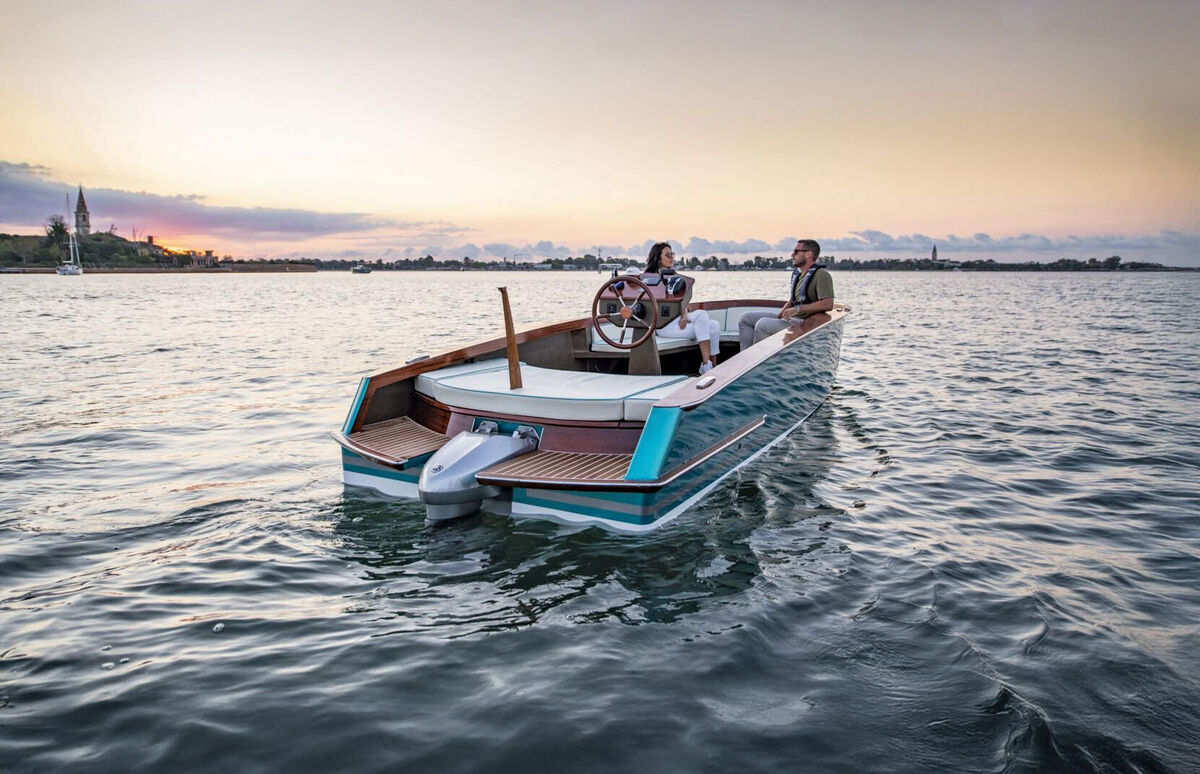
Charging Ahead
OEMs continue to invest as electric boating gains momentum
The maritime industry is on the cusp of a profound transformation, steering away from traditional fossil-fuel dependence toward a greener, more sustainable future. At the heart of this shift lies the burgeoning market for electric boats and their advanced propulsion systems.
Once considered a niche, electric boating is now gaining traction, driven by escalating environmental concerns, stringent emissions regulations and advancements in battery technology and electric motor efficiency.
“The market is evolving rapidly in the U.S. as battery technologies improve and costs continue to come down, making applications like leisure watercraft very viable solutions,” said Dr. John Warner, chief customer officer at American Battery Solutions (ABS), a subsidiary of Komatsu America Corp.
“There are also many learnings that are being passed along from larger IMO class ships which are seeing an intense growth in electrification,” he continued. “Additionally, the automotive segment leading the way in development is helping some of these adjacent electrification vehicles and vessels to take advantage of that market growth, as well.”
Boating Industry delves into the current state of the electric boat and propulsion market, exploring the key factors propelling its growth, the increasing popularity among recreational and commercial users, and the innovations poised to redefine marine travel for years to come.
Investment and innovation from OEMs
The growing interest in sustainable and quieter, cleaner boating experiences is resulting in significant investment and innovation from original equipment manufacturers (OEMs) in electric boats and propulsion systems.
Not only are OEMs electrifying existing models, but they’re also fundamentally rethinking vessel design and propulsion architecture.
Tyler Temple, CEO and founder of electric boat manufacturer Pollentia, said the company is working to expand its systems to be more efficient, powerful and future-ready.
“That includes smarter propulsion, better battery integration and technology that helps owners monitor performance and avoid unexpected issues,” he explained. “The goal is to make owning and operating an electric boat easier and more affordable at every level.”
Other OEMs are also developing high-performance hydrofoiling vessels, luxury solar-electric yachts and a diverse range of electric outboards, inboards and integrated hybrid systems.
In early 2024, Yamaha Motor Corporation acquired Torqeedo, an electric marine propulsion manufacturer. Dean Burnett, vice president, Yamaha U.S. Marine Business Unit, said the company plans on continuing to grow their offerings through collaboration with the manufacturer.
“Torqeedo offers a wide-ranging line of products, from electric outboard and inboard motors to batteries and various other accessories,” Burnett noted.
“It also holds many patents related to electric motors , propellers and electric systems, as well as the R&D capabilities, mass-production equipment and development resources for next-generation environmental technologies.”
The sheer volume and diversity of OEMs entering the electric marine space, coupled with significant strategic investments from major conglomerates like Brunswick and Volvo Penta, indicate that electric marine is no longer a fringe market. This broad engagement across luxury, high-performance and recreational segments signify a shift toward mainstream adoption.
Growing interest in sustainable boating
OEMs aren’t the only ones interested in this market – many boating consumers are also enthusiastic about finding cleaner, quieter and more cost-efficient ways to get on the water.
“Consumer interest is growing quickly,” said Temple. “The rising cost of fuel and engine maintenance is making electric a smarter choice long term. There’s also a new generation of boaters who expect their marine experience to match the smart, sustainable lifestyle they already have with EVs and solar at home.”
Gary Morehouse, owner of Coastal Yacht Management in South Carolina, said the dealership is seeing firsthand the growing momentum behind electric boats. The business sells Duffy electric boats, which have been around for over 50 years.
According to Morehouse, the OEMs’ continued innovation speaks volumes about where the market is heading.
“We're seeing increased consumer interest from both seasoned boaters and first-time buyers who are drawn to the simplicity and sustainability of electric propulsion,” he noted. “With no fuel costs, minimal mechanical upkeep and an incredibly smooth ride, Duffy boats offer a very appealing experience – especially for those cruising in no-wake zones or along coastal waterways.”
Consumer interest is particularly strong in recreational segments, according to Mobility Foresights ’ Global Electric Boat Market report, driven by an increasing demand from freshwater fishing and sailing enthusiasts who seek more sustainable and enjoyable boating experiences.
Interest is also being propelled by advancements in electric boat technology, including higher energy density in batteries and more efficient fast-charging solutions.
Yamaha’s Burnett also commented on the interest in electric boating. “General interest in electric boats among consumers seems to have increased slightly,” he said. “Electric sales have slowed down a bit over the last 12-18 months, but long term, we expect to see continued growth in the segment.”
On the other hand, Roxana Haghayegh, CMO at marine electric enterprise E-Force Marine, has noticed that Southern Florida consumers are more interested in seeking information rather than just buying an electric boat outright.
“It’s still too early and the choices available to them are close to none,” she said.
Concerns about electric boats
While there is undoubtedly interest in the electric boating segment, consumers still have a few concerns that leave them hesitant.
“In Southern Florida, consumers want to be able to sail to the Bahamas on their electric boats or be able to charge their boat fast,” Haghayegh explained. “While both of those are possible, the fast charging is something that we are currently seeking help with from our local government. We want to add one fast charging station to each public marina to help with the transition.”
There is also a high level of concern about engine longevity, according to Marine Futures founder and director Ollie Taylor.
“If an electric car breaks down or runs out of energy, you can simply call roadside assistance and someone will come to help,” he said. “On the sea, it’s a very different position. You generally need a much higher level of built-in redundancy to have that safety margin.”
According to Taylor, the two biggest concerns that consumers have are energy density and battery life. “We’re still one million miles away from where we need to be, but that may be resolved with technology in the long term,” he said.
There is also the challenge of infrastructure and ensuring that there are enough charging stations on docks.
“Having stable shore power is quite challenging in Europe and Mediterranean locations,” Taylor noted. “I’m not sure the infrastructure change will happen unless there’s significant customer demand for electric boats, but that’s not necessarily happening at the moment. Right now, they don’t want to take the risk.”
Yamaha’s Burnett mentioned that electric propulsion solutions on the water remain a challenge in the higher-horsepower categories due to the weight of the batteries and placement on the boat.
“We believe these electric solutions will continue to evolve, but today the lower horsepower electric outboard options tend to have better application on the water,” he said. “There is also an increased cost associated with electric propulsion versus traditional internal combustion engines. Charging infrastructure and the capacity of the grid will also continue to be an issue as more electric products enter the market.”
Leading OEMs driving momentum
Even though Taylor and Haghayegh address fundamental concerns over electric boating, OEMs are working to overcome these challenges with the right technology and innovation.
Innovation in the market is being spearheaded by a diverse group of OEMs, each carving out distinct niches based on performance, luxury and use case.
Candela Technology AB in Sweden, for example, is currently working on hydrofoiling electric boats, which is a technology that significantly reduces drag and boosts efficiency by lifting the hull above the water. The company’s C-8 day cruiser exemplifies this, featuring a 69 kWh Polestar battery, achieving 30 knots and offering a 57 nautical mile range.
Candela is also expanding into commercial electric ferries, such as the P-12 Shuttle, demonstrating the scalability of hydrofoil technology for zeroemission water transport. The C-8 Polestar Edition supports DC charging, allowing it to recharge from 10% to 80% in under 30 minutes.
Arc Boats in the U.S. is also focusing on high-performance, fully electric boats with an aerospace-inspired design. The 24-foot Arc One boasts a massive 220 kWh battery, reaching 40 knots with a 50-mile range. The newer 23-foot Arc Sport wake boat packs a 226 kWh battery and a 500-horsepower equivalent electric motor.
Yet another OEM leader is X Shore in Sweden, often dubbed the “Tesla of the Sea,” according to The Marine EV Leadership Series: The Top Companies . The company produces stylish, modular electric “smart boats” for both leisure and professional use.
X Shore models like the Eelex 8000 offer a 126 kWh battery and up to 100 nautical miles range. On the other hand, the more compact X Shore 1 reaches 30 knots with a 50-mile range. These vessels feature modular decks, touchscreen controls and sustainable materials.
Electric marine growth trajectory
The electric boat market is currently in an uptrend, with more than 100 manufacturers actively developing and introducing new solutions, according to Mobility Foresights’ Global Electric Boat Market report.
The Roots Analysis Electric Boat Market Size, Share, Trends & Insights Report found that Europe is currently leading this market, holding over 40% of the global electric boat market share. This regional dominance is largely attributed to supportive government regulations on marine emissions, which aim to minimize the environmental impact of boats.
JP Mancini, CEO of SeaEO, has seen impressive evolution in the electric power space over the years and predicts continued improvements.
“There are boats coming out that are really incredible,” he said. “The foundations have already been laid out for everything, such as the research development, the boat power, the batteries and the technology. Now, all we need is additional technology improvements.”
Agreeing with Mancini is Pollentia’s Temple, who said that as time goes on, improvements will continue to be made in electric boats.
“Battery power systems are now more efficient and affordable, motors are more powerful and consumers are much more open to electric,” he said. “The entire EV sector has matured, and marine is catching up. We’ve gone from basic retrofits and limited range to purpose-built electric platforms that can compete with gas engines while saving on fuel, maintenance and emissions.”
Consumer education plays a huge part in keeping the momentum going. If boaters understand that battery life and power are increasing, they won’t be as worried about getting stranded on the water.
"Consumer interest continues to increase," said Burnett. "As consumers become more familiar with the electric options available and their intended applications, electric power will continue to evolve to meet demand."
OEMs are passionate about not only educating consumers around electric boats, but also about continuing to innovate and bring better boats to life.
“Our vision is to help build a true global marine charging network, with fast, high-capacity chargers at marinas and ports,” noted Temple. “At the same time, we want owners to have the ability to charge their boats at home, just like they would an electric car. Flexibility is key. Whether you're docked overnight or out on a trip, you shouldn’t have to worry about where or how long it’ll take to recharge. Access, speed and scalability are what we’re pushing to improve.”