Propelling the Future: How the marine industry is charting resilience
Recreational boating in the U.S. generates $230 billion annually, supports more than 36,000 businesses, and builds 95% of boats sold in the U.S. right here at home. As we look to the future, it’s clear that boating is evolving – driven by new technologies, shifting market dynamics, and a complex global landscape.
In my role with the National Marine Manufacturers Association (NMMA), I see firsthand how manufacturers, dealers, and partners across the industry are rising to the moment, working to ensure boating remains accessible , sustainable, and resilient for the next generation.
Innovation, environmental stewardship and self-regulation
For more than 20 years, NMMA has helped the global recreational boating industry create a better boating experience that reduces its environmental footprint . And since 2000, marine engine emissions have dropped by more than 90%. Though recreational boats account for less than 0.01% of global emissions , NMMA recognizes the need to go the extra mile to make boating more sustainable.
That’s why the International Council of Marine Industry Associations (ICO- MIA) and NMMA launched Propelling Our Future, a global initiative to provide guidance and resources to policymakers and industry leaders that will further improve the environmental performance of the recreational boating sector.
This included first-of-its-kind, independent research – Pathways to Propulsion Decarbonisation for the Recreational Marine Industry – commissioned by ICOMIA with leading global engineering consulting firm Ricardo plc to better understand how to further reduce emissions and provide guidance to global governments as they work together to shape investments in technology and policy. The core finding is clear : there is no one-size-fits-all solution to decarbonize the industry.
Propulsion technologies
The Pathways research highlighted the fact that recreational boating has different needs due to the unique on-water environment and varied interests of boaters and types of on-water experiences. This calls for an approach that recognizes the limitations of certain technologies based on boat type and usage.
That means the future depends on innovation and a variety of technologies, including:
-
Strategic maritime fuels (also known as sustainable marine fuels): Currently the strongest and most suitable path to reduce emissions in the existing fleet without compromising distance or performance, or requiring any changes to the boat, engine or fueling system.
-
Hydrogen: An emerging, but promising solution as its production process is optimized.
-
Electric: A workable option in the right applications, but not universally suitable until there is a battery density breakthrough.
-
Hybrid systems: A good option for boats used for longer periods of time and for longer distances, combining electric and internal combustion engines powered by liquid fuel.
This technology-neutral, use-case-driven approach is essential for industry momentum and resilience.
Propelling Our Future in action
Through Propelling Our Future, NMMA is bringing together the global industry to educate stakeholders and advance these technology solutions. Forward-thinking manufacturers are delivering technologies that make boating cleaner, safer and more enjoyable.
These innovations – from strategic maritime fuels to onboard safety and navigation systems – are not theoretical . They are operational and already helping the industry become more resilient to environmental and regulatory pressures while protecting the waters we love.
Global collaboration, local impact
To scale these innovations, NMMA is working closely with global governments, researchers and industry stakeholders to harmonize marine standards and regulations and ensure the infrastructure and policies to support these solutions are in place.
Since launching Propelling Our Future at Metstrade in 2023, the global collaboration has helped:
-
Advance legislation that prioritizes the development and distribution of strategic maritime fuels.
-
Work with lawmakers to highlight the recreational marine industry’s role in helping to solve energy and environmental challenges.
-
Launch a comprehensive Sustainable Maritime Fuel Grand Challenge to modernize aging marina fueling infrastructure.
-
Expand research and development support for hydrogen propulsion, battery density and advanced fuel technologies.
-
Work alongside the U.S. Department of Energy to develop a Maritime Action Plan which recognizes the important role of recreational boats in overall maritime activities.
-
Roll out consumer education campaigns that support the adoption of alternative fuels.
-
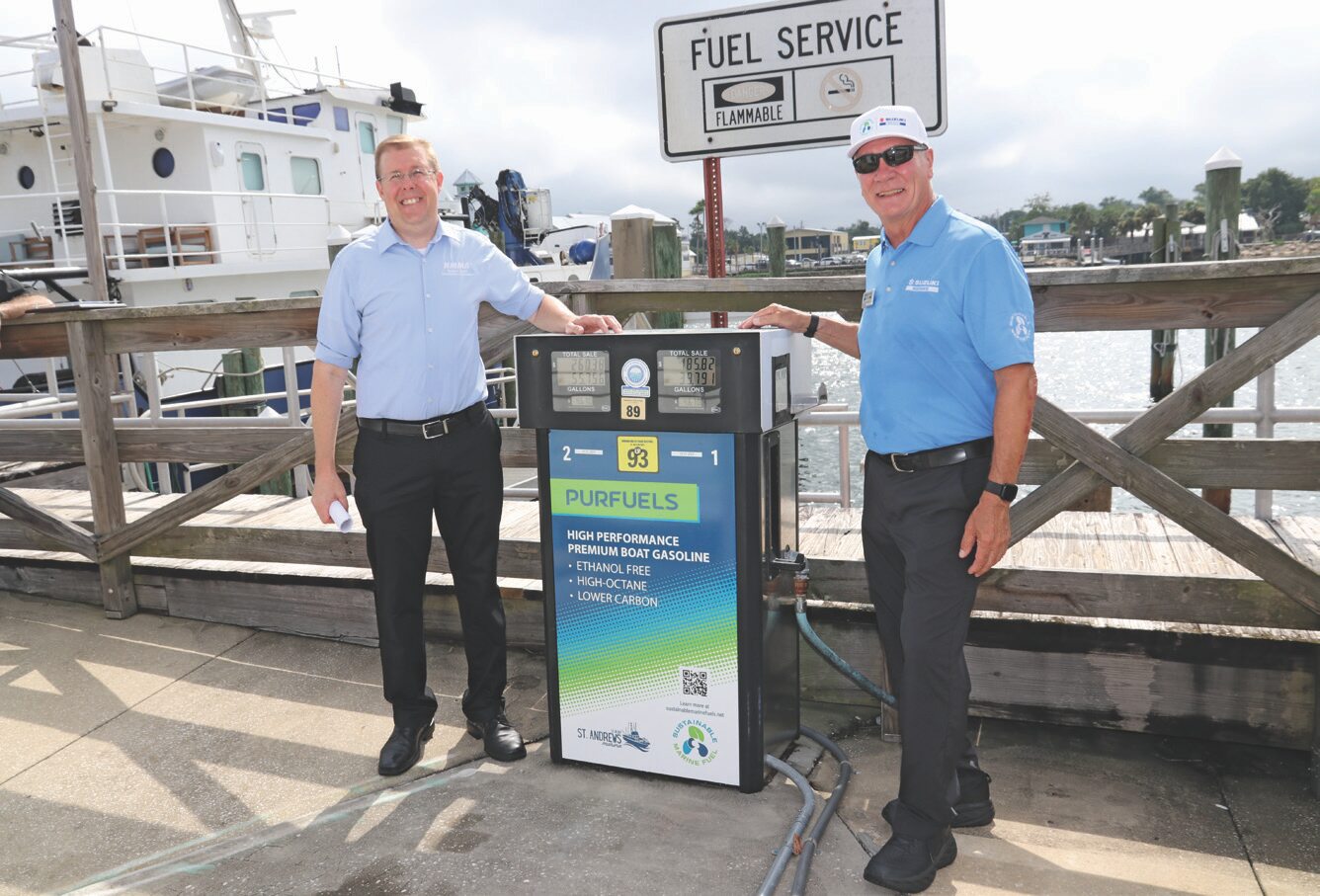
Partner with NMMA members to pilot strategic maritime fuels. Last year, alongside Suzuki Marine, Hyperfuels and LyondellBasell, NMMA launched the first-ever pilot program for strategic maritime fuels at St. Andrews Marina in Panama City, Florida, making them available to boaters for the first time at a local marina. The pilot program helped identify the process and systems needed to ship, store and distribute strategic maritime fuels to help shape distribution models around the country and globe.
Future-proofing boating
At its core, this transformation is about more than emissions reduction; it’s about future-proofing the marine sector. By investing in resilient infrastructure, diverse propulsion technologies and smarter manufacturing processes, we’re creating an industry that not only can withstand economic , environmental and regulatory changes, it can thrive.
Looking ahead, NMMA is focused on:
-
Encouraging public policy that takes a technology-neutral approach, supports innovation and considers a variety of energy or propulsion systems.
-
Accelerating the development and distribution of strategic maritime fuels. This includes continuing to partner with members to pilot strategic maritime fuels at select marinas and launching consumer education campaigns that support the adoption of these new fuels.
-
Partnering with consumer safety and government entities to establish marine electric technology standards and consumer safety protocols.
-
Working with government leaders to expand funding for research and development to improve electric battery density and hydrogen research that can be applied to the marine environment.
-
Conducting additional research to evaluate existing and emerging technologies and how to best apply them to the unique marine environment.
Jeff Wasil is the vice president of environmental compliance and marine technology for the National Marine Manufacturers Association.