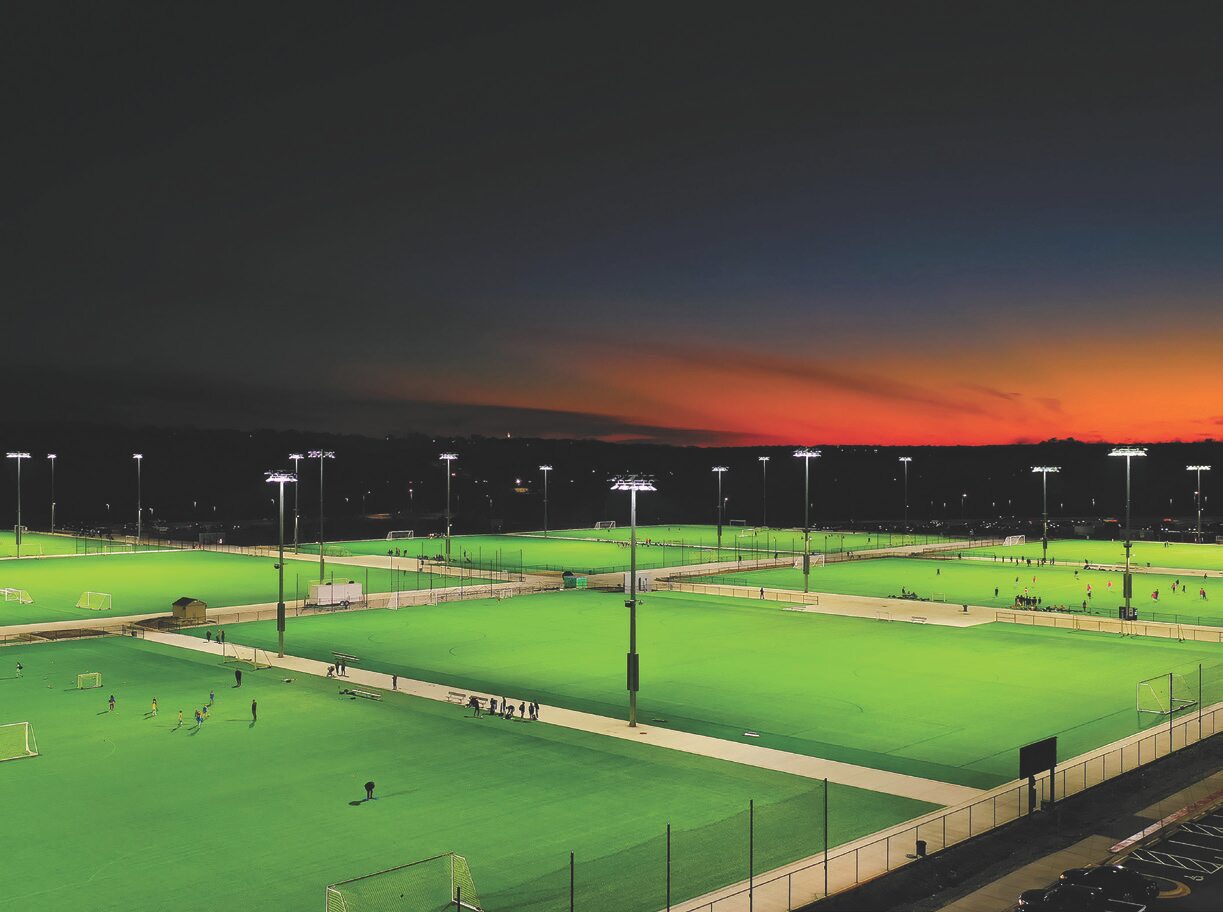
The Evolution of Field Lighting Systems
By Mary Helen Sprecher
The first generation of LED sports lighting hit the market shortly after the first decade of the new millennium. Manufacturers peg the window as being anywhere between 2010 and 2014.
One thing that can’t be disputed is the big milestone: The first NFL game to be played under LED lighting took place at what is now State Farm Stadium in Phoenix in 2015 — and that was Super Bowl XLIX. And that, by all accounts, was a remarkable first impression.
Early adopters were impressed by the multiple advantages LED field lighting offered: truer color rendition, an absence of glare, better ability to be directed (thus eliminating light trespass), a lack of sky glow and, of course, the enhanced energy efficiency.
But, as with all technologies, LED has undergone improvement over the years.
“In many cases, first-generation LED products could not be repaired or upgraded,” said Bruce Frasure of Frasure Reps. “This led to costly replacements.”
Systems on the market today, he noted, have become future proof.
“In response, lighting manufacturers are moving toward more sustainable designs,” said Frasure. “Key components include interchangeable LED arrays, smart drivers, and modular designs for long-term value. This approach moves beyond disposable fixtures and reduces electronic waste.”
A better class of lighting
New and improved LED systems offer the ability to be controlled by a mobile app that allows fixtures to be dimmed when not in use, as well as to hit full power if motion on the field trips them, something that can enhance security and deter unauthorized entry.
The quality of the light itself also has improved in ways original adopters might never have envisioned.
“Recent advancements have pushed LED lighting beyond basic white illumination,” said Jordan Davila of Sportsbeams. “Innovations now include precision optics to reduce glare, durable aluminum housings for thermal management, and integrated color-changing (RGBA) and high-quality broadcast-white capabilities that allow facilities to support events and community engagement without sacrificing performance.”
Manufacturers say there is every reason to assume that progress will continue to be made.
“LED performance just continues to improve,” said Jordan Barker of StressCrete Group. “That means efficacy improves along with optical performance. The IoT is also something that is much more compatible with LED, so the options for new technology to be bolted on continues to improve/evolve. It’s the difference between an emerging/growing technology and the mature technology we saw in HID [high-tensity discharge] lighting.”
Technology driving advanced LED adoption
Unlike fields of generations past, today’s sports facilities may routinely have livestreaming and athlete analysis technology, two things that were barely a blip on the radar when LED was first adopted. As a result, fields now require higher levels of lighting to support recordings and make them worthwhile to those watching them.
Streaming and analysis technology, in conjunction with better lighting, create a more marketable facility, meaning one that is more in demand for tournaments, player showcases, meets, championships, combines and other events where athletes at the youth level might be seen by prospective college coaches or pro scouts.
Field infrastructure reuse
Early on, a selling point for LED was the ability of field managers to save money by reusing existing poles around the facility. But according to contractors, taking that course should only be done after a professional performs a review of the infrastructure.
“The main thing owners have to consider is the structural integrity of their existing poles to ensure they are good candidates for new fixtures, and also to consider how they attach to the poles,” said Todd Dettor of Fast-Dry Courts and Tweener Lighting Systems. “New mounting brackets may be needed as well.”
However, said Nick Schultz, also from Fast-Dry and Tweener, the restrictions of the site may be a hindrance to the upgrade.
“Often, it isn’t possible to install footers for recommended light pole locations due to infrastructure or landscaping surrounding facilities,” said Schultz. “Also, more and more environmental restrictions are being enforced every year, which are making it increasingly difficult to meet light height and spillage requirements, dark sky ordinances, etc., while also lighting the facility properly.”
Choose lighting vendors carefully
The market continues to evolve; however, at the same time, there are forces that threaten its progress. One place this is evident is on the internet, where pop-up ads show inexpensive lighting systems.
“Facility owners should be cautious of low-cost, white-
labeled LED products commonly found online,” said Davila. “These fixtures often use lower-quality components, such as plastic lenses, which can yellow or degrade over time, similar to automotive headlights. This results in reduced output and inconsistent performance. Purpose-built fixtures use durable materials to help ensure long-term reliability.”
Prior to purchasing a lighting system, owners should research the vendors in the marketplace and the options offered and consider the importance of selecting a system that is manufactured, tested and backed by a reputable company.
Keep in mind that inexpensive equipment, such as that purchased online without an onsite sales representative who can make an in-person visit to the facility, also may have limited functionality. This may lead to a need to replace the whole system sooner rather than later.
Additionally, many inexpensive systems are manufactured outside of the country and may not offer the buyer any customer support once the product arrives. The wiser investment is made by purchasing a domestically manufactured sports-specific system that is backed by a reputable company with references from users who can speak
about the customer service experience before, during and after installation.
Environmental concerns
Something else that has evolved right along with LED itself is the discussion around the adoption of any outdoor lighting system, and sports fields are no exception.
As more communities build outdoor sports facilities in land-locked areas, the impact of lighting on the surrounding environment is an increasing concern.
In fact, uncontrolled light can be just as much a source of ill will with neighbors as can increased traffic and parking congestion caused by sports facilities, all factors that can and should be addressed in the planning process.
In addition to these problems, uncontrolled light has a negative effect on local wildlife and plants
According to the DesignLights Consortium (DLC), the following recommendations are made in order to lower environmental impact:
Use outdoor lighting that is dimmable and control-ready
Consult with local experts on wildlife to ascertain any potential threats and how to mitigate them
Communicate with neighbors in the area to understand their concerns and to discuss the way lighting will be controlled so as not to become a nuisance
Use the right amount of light
Control lighting to reduce energy use and light pollution
Control lighting to respond to seasonal changes in the environment.
Control the distribution of light.
Minimize blue-violet light (exposure to this form of light has been linked to retina damage that could lead to Age-Related Macular Degeneration, which can cause irreversible vision loss).
Keeping field lighting updated and in peak condition means not only employing the newest technologies but staying on a regular schedule of maintenance.
Mary Helen Sprecher wrote this article on behalf of the American Sports Builders Association (ASBA). For more information, see ASBA’s Sports Fields: Construction and Maintenance Manual, available in both PDF and hard copy at www.sportsbuilders.org.