Can you identify this turfgrass problem?
Problem: Blue areas on cement
Turfgrass area: Home lawn
Location: North Florida
Turfgrass variety: Centipede grass
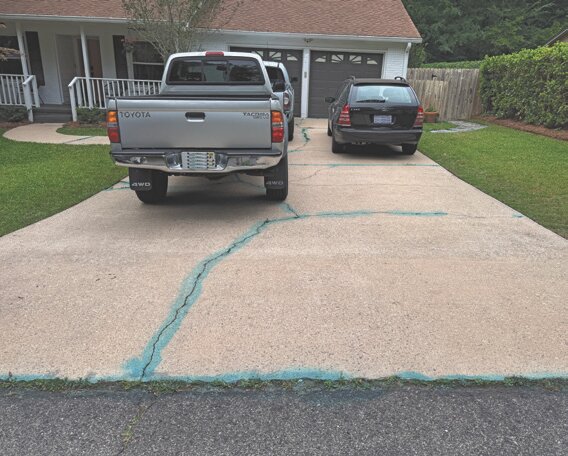
Answer:
The blue areas on this cement driveway were the result of a lawn maintenance company’s attempt at spot weed control. As all of us know, tracker dye is a non-hazardous indicator dye added to spray tank mixes to properly identify areas covered with the application spray. This improves accuracy and aids in the ability to see areas treated with chemicals like this Glyphosate application. Most quality tracker dyes, when applied to turfgrass areas, will not stain long term, and the temporary color usually disappears with rain, irrigation or sunlight. However, as in this instance, when tracker dyes come onto contact with concrete, they can leave permanent or long-lasting stains. If tracker dye gets on concrete, the best course of action is to try and rinse it immediately with water or use a strong cleaning agent such as a sodium hypochlorite (bleach) solution. Common sense should be used when spraying weeds in cement areas like these driveway cracks. After application, this tracker dye was allowed to dry thoroughly and was visible on this driveway for a couple weeks. The only good thing you can say about this was that he had pretty good coverage.
Photo from John Mascaro’s collection.
John Mascaro is president of Turf-Tec International
If you would like to submit a photograph for John Mascaro’s Photo Quiz, please send a high-resolution digital photo to John Mascaro via email at john@turf-tec.com. If your photograph is selected, you will receive full credit. All photos submitted will become property of SportsField Management magazine and the Sports Field Management Association.