Field Tested
University of Tennessee’s turfgrass students are growing careers on the global stage
By Brian Canever
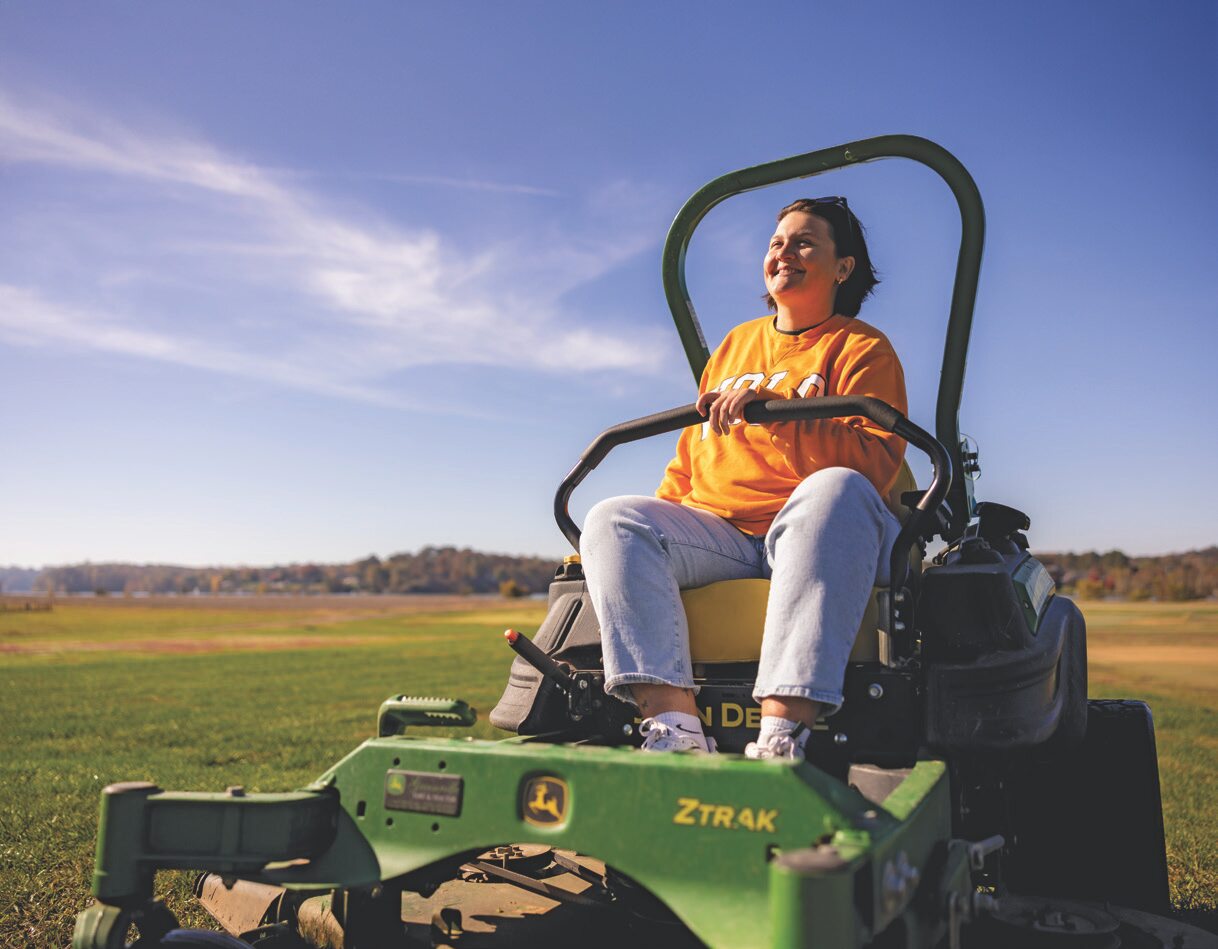
The sun has barely crept up over the horizon at the University of Tennessee (UT) AgResearch and Education Center, a 200-acre tract of land just south of the Knoxville campus where plant and soil science students are at work doing research that, quite literally, touches the world. The sound of a lawnmower firing in the distance breaks the silence. Before long, Rose Gibbons, a turfgrass science and management undergraduate who spent the summer interning at the center, rides out, ready to do her morning’s labor.
Small plots of various species of grass are set up for UT turfgrass science professors to study. Gibbons, a transfer student from Illinois, worked in commercial landscaping before moving to Knoxville and realizing that she had moved only a few miles from one of North America’s most elite turfgrass education programs. Two years into her studies, she’s already completed internships with Major League Baseball’s Baltimore Orioles and helped to prepare the field at Orlando’s Inter & Co Stadium for this past summer’s FIFA Club World Cup 2025.
As Gibbons finishes her mowing, trading one piece of equipment for another, the morning’s rays shine on a building behind her that is proof of how highly UT is regarded in this discipline.
“That’s the FIFA building,” said Gibbons, who helped install and maintains the plots of grass inside. This is the testing ground for the playing surfaces that billions of people will see when the men’s FIFA World Cup 26 kicks off in North America. Gibbons and about 15 other UT undergraduates are involved with a long list of research and performance activities, from testing for ball bounce, grass color, and player safety, to simulating traffic and indoor stadium conditions for surfaces that will host 104 matches across 16 stadiums in Canada, Mexico, and the United States. It’s hard, daunting work.
“But it’s also about the most fun you can have while getting paid,” said Gibbons.
“We’re a hidden gem,” said Brandon Horvath, Ph.D., one of a core of four professors in the UT turfgrass program. Horvath recently took the reins as the undergraduate coordinator from Distinguished Professor of Turfgrass Science and Management John Sorochan, Ph.D., who is leading the research project for FIFA. “A few years ago, we worked with an advertising agency and the first thing they told us was, ‘Nobody knows about you.’”
But they should. Besides the university’s collaboration with FIFA to develop the field surfaces for the Club World Cup last summer and FIFA World Cup 26, UT’s teaching, research and Extension faculty — which includes Horvath, Sorochan, Jim Brosnan, Ph.D., and Becky Bowling, Ph.D. — has placed students at the Super Bowl and the Masters at Augusta National, among many other prestigious locations. A December 2025 alumnus from New Jersey, Andrew Evans, interned with the Philadelphia Eagles — his favorite pro football team — and worked at Super Bowl LIX in New Orleans.
The result of these prestigious internships is evident in the program’s 100-percent job placement rate. According to a network map that Bowling updates regularly, there are hundreds of UT turfgrass alumni presently working across 17 states in golf courses, parks and recreation departments, and for sports teams.
“Very few people understand the level of science and depth of knowledge it takes to maintain a world-championship-level golf course or soccer pitch,” said Horvath. “But at UT, that’s what we’ve always sought to teach our students.”
The expertise they gain during their undergraduate years opens a wealth of career opportunities. Take for example, Ivan Navarrette, who came to UT from nearby Loudon, Tennessee, and earned his bachelor’s and master’s degrees in plant sciences. FIFA representatives were so impressed with Navarrette when he was a student working on the AgResearch Farm that they offered him a job as a stadium pitch operations supervisor in Mexico ahead of the FIFA World Cup 26 tournament. And there are numerous other areas in which graduates make an impact every day.
“The turfgrass industry has five major sectors,” said Bowling. “Golf, sports turf, seed and sod production, community turf, and lawn and landscape. Nationally, we’re estimated to contribute approximately $60 billion to $100 billion to the economy. UT students and alumni play a role in every facet of that contribution.”
UT’s alumni are also prominent in academia. Master’s and Ph.D. graduates of UT at high-intensity research universities include Adam Thoms (MS ‘08, Ph.D. ‘15) at Iowa State, Jay McCurdy (MS ‘08) at Mississippi State, and Matthew Elmore (MS ‘11, Ph.D. ‘14) at Rutgers.
Conlan Burbrink (BS ‘20) earned a master’s degree at Texas A&M before returning for his Ph.D. studies in 2022 under Sorochan, who was his undergraduate mentor. While at UT, the Cincinnati native has worked the Super Bowl, the Cricket World Cup, and interned with the Cincinnati Reds Urban Youth Academy, Orlando City Soccer Club, and Surrey County Cricket Club in England. From a research perspective, he’s curious about two areas: growing grass indoors, particularly the effect of light and color, and how the field of turfgrass science can be advanced through data analytics.
“Turfgrass isn’t just growing grass — it’s how the athlete interacts with it, how the environment interacts with it,” said Burbrink. “I’m using statistical techniques that aren’t typically used in agronomics, like machine learning and AI, to answer more complex questions about turf performance.”
Burbrink was on the pitch in Qatar for the 2022 World Cup tournament, where the heat was so stifling that large air conditioning units had to be custom-built for FIFA spectators and players. The men’s FIFA tournament will be hosted in 2030 by six countries — Argentina, Paraguay, Uruguay, Spain, Portugal, and Morocco — and four years later will be held in Saudi Arabia. Because Burbrink’s research is future-focused, the FIFA research project is an incredible opportunity to test hypotheses about indoor grass conditions that may benefit the organization for years to come.
“There’s no facility in turfgrass that compares to what we have on the AgResearch farm,” said Burbrink. “It’s completely enclosed, no natural light, so that we can answer both practical and physiological questions. FIFA’s support to build that building and conduct this research allows us to further turfgrass science as a discipline.”
Bowling, a co-principal investigator on the FIFA research project, coordinates field research days, where faculty from UT and Michigan State University convene with pitch managers from each host venue and FIFA’s pitch management team. The events have provided a unique opportunity for UT’s students to be a part of global work with real-life outcomes.
“These are high-profile international events that we help facilitate on behalf of FIFA, and the scale and visibility require an all-hands-on-deck approach,” said Bowling. “Our students consistently rise to meet that challenge.”
Most exciting for Bowling and Horvath has been watching students step into leadership roles on the FIFA research collaboration. Rhys Fielder earned his bachelor’s degree in turfgrass science and management from UT in 2019. During that time, faculty members helped him land an internship with English Premier League club Arsenal. After graduating, he enrolled in the master’s program and currently serves as the research lead for the FIFA project.
“Before working on a golf course, I had no idea turfgrass even existed as a profession,” said Fielder. “I knew someone came in and mowed the grass. But the sophistication behind it was mind blowing.”
Said Horvath, “There are many programs out there that tell students to wait until their junior year to take an internship. But you’ve got to get experience working in different settings, under different managers, to learn about yourself and what you like. John [Sorochan] says, ‘Work like labor and think like management.’ This is a management degree, and it requires critical thinking and problem-solving skills. When you leave our program, you’re ready to lead.”
Gibbons, who was unsure of what she wanted to do with her life between finishing community college and moving to Tennessee, is now president of the Tennessee Turf Club. She’s enjoying working on the hybrid grass system, and is championing the message of “safe and uniform playing surfaces” that the FIFA project emphasizes. She expects to enroll in the master’s program after graduating this fall.
“There are so many benefits to being here,” said Gibbons. “I get to be outside and work with people I like. Our professors can connect us with any turfgrass person in the world in a five-minute phone call. The sky really is the limit.”